Within Radio Rumors
Did Radio Teach People How to Hear UFOs?
The 1938 broadcast did not cause flying-saucer belief, but it trained audiences to hear science fiction in news-like form.
On this page
- How the broadcast sounded like breaking news
- Why the panic story was later exaggerated
- What the format taught early UFO audiences
Page outline Jump by section
Introduction
Did radio teach people how to hear UFOs? Not directly. The famous 1938 broadcast of The War of the Worlds did not create later belief in flying saucers, and historians now agree that the scale of the alleged nationwide panic was greatly exaggerated. Yet the programme mattered for a different reason. It demonstrated how science fiction could be delivered through the conventions of trusted news reporting, complete with interruptions, expert voices, location updates and a sense of unfolding emergency. When flying-saucer stories erupted across American media in 1947, audiences were already familiar with the experience of hearing extraordinary events presented in a news-like format. The connection is less about mass deception than about media habits: radio had already shown how strange stories could feel immediate, urgent and plausibly real.[Wikipedia]WikipediaThe War of the Worlds (1938 radio dramaThe War of the Worlds (1938 radio drama
How the Broadcast Sounded Like Breaking News
Orson Welles’s adaptation of The War of the Worlds was structured to resemble live radio coverage rather than a conventional drama. Dance music was interrupted by increasingly alarming bulletins describing unusual astronomical observations, explosions on a farm in New Jersey and the arrival of hostile Martians. Listeners encountered what sounded like eyewitness reports, official statements and on-the-scene correspondents.
The technique mattered because radio was then the dominant medium for receiving urgent information. In the late 1930s, audiences were accustomed to hearing genuine breaking reports interrupt regular programming. The broadcast borrowed those familiar signals of authority and immediacy. Even though CBS identified the programme as a drama, some listeners tuned in after the introduction and encountered only the simulated news format. Authorities, newspapers and radio stations received calls from people seeking confirmation of what they had heard.[Docslib]docslib.orgradios war of the worlds broadcast 1938Radio's War of the Worlds Broadcast (1938) - DocsLib…
For the history of UFO culture, the significance lies in the format rather than the fictional Martian invasion. The broadcast demonstrated that a story could move back and forth between entertainment and perceived reality when presented through recognisable news conventions.
Why the Panic Story Was Later Exaggerated
Popular memory often describes The War of the Worlds as causing nationwide hysteria. Modern historical research paints a more restrained picture.
Later studies found that the panic was far less extensive than newspaper accounts suggested. Many people never heard the programme at all. Among those who did, reactions ranged from amusement to temporary confusion, with only a minority displaying genuine alarm. Historians have argued that newspapers had incentives to emphasise radio’s dangers because radio had become a major competitor for audiences and advertising. Researchers have also noted that many listeners who contacted authorities were not blindly accepting the story; they were actively checking whether it was true.[Wikipedia]WikipediaThe War of the Worlds (1938 radio dramaThe War of the Worlds (1938 radio drama
This reassessment is important because it changes the lesson. If the event had simply shown that audiences would believe anything, it would have limited relevance to later UFO history. Instead, the evidence suggests something more subtle: people used media networks to verify extraordinary claims. They phoned police stations, newspapers and friends. In other words, they treated unusual information as news requiring confirmation rather than fiction requiring interpretation.[Wikipedia]WikipediaThe War of the Worlds (1938 radio dramaThe War of the Worlds (1938 radio drama
That habit would become familiar during later UFO waves, when witnesses, journalists and officials repeatedly attempted to verify reports spreading through newspapers, radio broadcasts and wire services.
What the Format Taught Early UFO Audiences
When the flying-saucer craze began in 1947, Americans encountered reports through media channels that already blurred the boundaries between speculation, entertainment and news.
The lesson of The War of the Worlds was not that aliens were real. The lesson was that extraordinary claims could arrive packaged as breaking developments. Listeners had already experienced a narrative in which scattered reports accumulated into a national emergency. That structure resembled the way many UFO stories later spread:
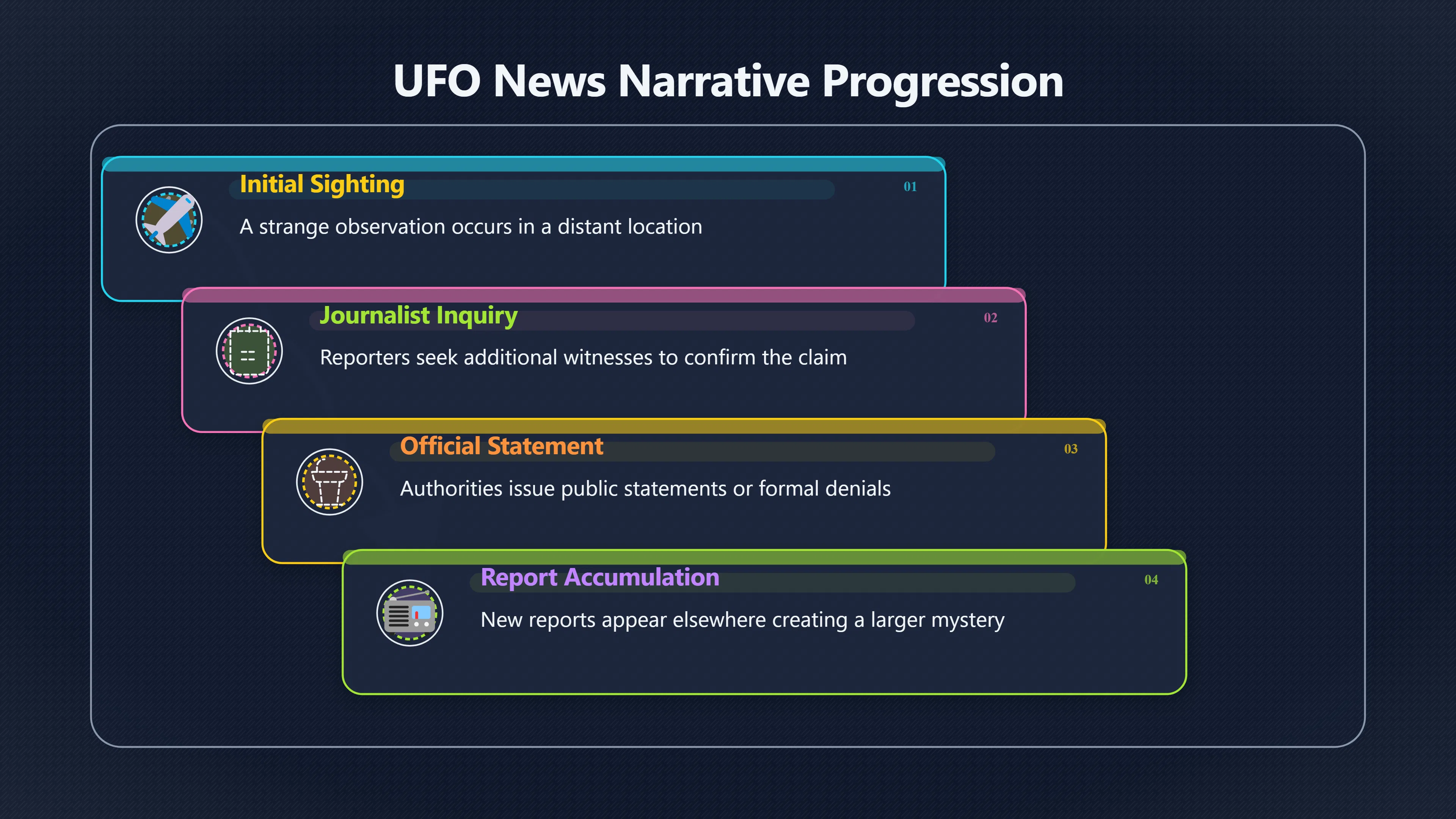
- A strange observation is reported from a distant location.
- Journalists seek additional witnesses.
- Authorities issue statements or denials.
- New reports appear elsewhere.
- The growing number of reports becomes part of the story itself.
The flying-saucer wave of 1947 followed precisely this pattern. After Kenneth Arnold’s sighting near Mount Rainier, newspapers and radio stations rapidly circulated reports from across the United States. Within weeks, hundreds of sightings were being discussed publicly, and the accumulation of reports helped create the impression of a larger mystery.[Wikipedia]WikipediaFlight 105 UFO sightingFlight 105 UFO sighting
What audiences had learned from radio drama was not belief in spacecraft but familiarity with a narrative rhythm: isolated incidents becoming a national event through repeated news updates.
From Fictional Invasion to UFO News Culture
The relationship between The War of the Worlds and UFO culture illustrates a broader connection between science fiction and public understanding of unexplained phenomena.
Before flying saucers became a major news topic, radio had already trained audiences to process fantastic possibilities through realistic reporting styles. Science-fiction ideas no longer had to appear only in novels or magazines. They could be delivered in the language of journalism, experts, bulletins and eyewitness testimony.
When UFO reports later appeared in newspapers and on radio broadcasts, many listeners already possessed a cultural template for hearing astonishing claims presented as current events. The result was not automatic belief. Rather, audiences had learned how to follow an unfolding mystery: listening for updates, comparing reports, seeking confirmation and imagining larger explanations connecting scattered observations.
In that sense, The War of the Worlds occupies an important place in the history of UFO news habits. It did not create the flying-saucer era, but it helped familiarise audiences with a media form in which science-fictional possibilities could be experienced through the sounds and rhythms of breaking news.[Wikipedia]WikipediaThe War of the Worlds (1938 radio dramaThe War of the Worlds (1938 radio drama
Amazon book picks
Further Reading
Books and field guides related to Did Radio Teach People How to Hear UFOs?. Use these as the next step if you want deeper reading beyond the article.
The Flying Saucers are Real
Shows how later UFO narratives benefited from existing media habits.
The War of the Worlds
Central cultural source behind the radio adaptation discussed on the page.
The Demon-Haunted World
Rating: 4.5/5 from 43 Google Books ratings
Explores belief, media influence, and extraordinary claims.
eBay marketplace picks
Marketplace Samples
Live-tested eBay searches with available results related to this page.


Endnotes
1.
Source: Wikipedia
Title: The War of the Worlds (1938 radio drama)
Link:https://en.wikipedia.org/wiki/The_War_of_the_Worlds_%281938_radio_drama%29
2.
Source: docslib.org
Title: radios war of the worlds broadcast 1938
Link:https://docslib.org/doc/2452839/radios-war-of-the-worlds-broadcast-1938
Source snippet
Radio's War of the Worlds Broadcast (1938) - DocsLib...
3.
Source: Wikipedia
Title: Flight 105 UFO sighting
Link:https://en.wikipedia.org/wiki/Flight_105_UFO_sighting
4.
Source: youtube.com
Link:https://www.youtube.com/watch?v=5AiTcP-nApM
Source snippet
Orson Welles - War Of The Worlds - Radio Broadcast 1938...
5.
Source: youtube.com
Title: Orson Welles
Link:https://www.youtube.com/watch?v=Xs0K4ApWl4g
Source snippet
The War of the Worlds – The Greatest (Unintentional) Hoax in History | Orson Welles, 1938...
Additional References
6.
Source: youtube.com
Link:https://www.youtube.com/watch?v=t6cwaB8L03s
Source snippet
Did War of the Worlds REALLY Cause a Mass Panic?...
7.
Source: isgp-studies.com
Title: 1947 07 07 scotsman flying saucers baffle us
Link:https://www.isgp-studies.com/misc/UFOs/press-reports/1947-07-07-scotsman-flying-saucers-baffle-us
Source snippet
"Flying Saucers" Baffle U.S.: Planes Ready to Pursue Mystery Objects; Speed of 1200 M.P.H...
8.
Source: youtube.com
Title: Did War of the Worlds REALLY Cause a Mass Panic?
Link:https://www.youtube.com/watch?v=Xey_DsBUIV4
Source snippet
WAR OF THE WORLDS: The Original Orson Welles Broadcast with AI Footage (1938)...
9.
Source: knkx.org
Link:https://www.knkx.org/other-news/2011-06-24/64th-anniversary-of-flying-saucers-at-mt-rainier
Source snippet
June 24, 2011...
Published: June 24, 2011
10.
Source: youtube.com
Link:https://www.youtube.com/watch?v=EOIZxYb3UcY
Topic Tree