Within UFO Fiction
How Real Rockets Changed UFO Imagination
Real rockets, missiles, and aircraft made science-fictional UFO stories feel newly possible after the Second World War.
On this page
- Wartime weapons and public shock
- Spaceflight as a believable future
- Why technology blurred fiction and possibility

Page outline Jump by section
Introduction
Real rockets made UFOs feel technically plausible. Before the Second World War, strange objects in the sky could be imagined as omens, airships, hallucinations, secret inventions or visitors from other worlds. After 1945, the mental shortcut changed: people had seen rockets, jet aircraft, radar, guided weapons and atomic technology move from speculative fiction into military reality. That did not prove that UFOs were alien spacecraft, but it made extraordinary aerial machines seem less like fantasy and more like a possible next step.
This matters for the relationship between UFOs and science fiction because the post-war UFO imagination was not built from fiction alone. It was built from fiction plus real technology: the V-2 missile, the jet age, early guided weapons, secret reconnaissance aircraft, Cold War missile anxiety and the promise of spaceflight. Science fiction supplied story shapes; rockets and advanced aircraft supplied a new standard of plausibility.
Wartime weapons and public shock
The German V-2 was the key psychological break. The Smithsonian National Air and Space Museum describes it as the world’s first large-scale liquid-propellant rocket vehicle, the first modern long-range ballistic missile and the ancestor of later large liquid-fuel rockets and launch vehicles. It was not a rumour, pulp-magazine illustration or laboratory curiosity. It was a working weapon that crossed borders at high speed, arrived with little warning and made the upper atmosphere feel militarily reachable.[National Air and Space Museum]airandspace.si.eduNational Air and Space MuseumV-2 MissileThe German V-2 rocket was the world's first large-scale liquid-propellant rocket vehicle, the fir…
That changed how post-war observers could interpret the sky. If an object was fast, silent, luminous, high-flying or strangely shaped, the question no longer had to jump directly from “natural phenomenon” to “impossible”. A third category had become vivid: secret technology. The V-2 showed that governments could possess machines more advanced than the public expected, and that wartime research could remain partly hidden. In UFO culture, that idea became crucial. Many reports could be discussed as possible enemy devices, captured German weapons, experimental aircraft, or technologies beyond ordinary aviation.
The “ghost rockets” reported over Scandinavia in 1946 show this mechanism clearly. Before the American flying-saucer wave of 1947, witnesses in Sweden, Finland and nearby regions reported rocket-like or missile-like objects. Contemporary speculation often centred on whether the Soviet Union was testing captured German V-1 or V-2 technology. A declassified Central Intelligence Group memorandum from August 1946 treated the reports as a security matter and discussed the possibility of missiles linked to Peenemünde, the German rocket centre, rather than treating the sightings mainly as folklore or entertainment.[CIA]cia.govOpen source on cia.gov.
The important point is not that the ghost rockets were proven to be Soviet missiles. They were not. Many reports were vague, some may have involved meteors or other ordinary causes, and no decisive wreckage established a single technological explanation. The important point is that “rocket” had become the natural interpretive frame. A generation earlier, an odd light might have been fitted into airship rumours or celestial mystery. In 1946, it could be understood through captured weapons, ballistic tests and geopolitical secrecy.
This is one of the cleanest examples of real technology shaping UFO imagination before the familiar flying saucer solidified. The objects were not yet standard cinematic discs. They were often imagined as projectiles: fast, directed, possibly weaponised and probably state-made. That early language helps explain why UFO stories so quickly belonged not only to science fiction, but also to defence ministries, intelligence agencies and newspapers covering strategic anxiety.

Spaceflight as a believable future
The V-2 also made spaceflight seem less remote. The same technology that had terrorised cities became a foundation for post-war rocketry and the Space Age. The Science Museum in London describes the V-2 as a harbinger of the Cold War missile age and connects it to the later space race, while the Smithsonian’s museum display history treats the V-2 as an object that bridges wartime violence and later public narratives of living in the Space Age.[Library of Congress Tiles]tile.loc.govOpen source on loc.gov.
This double identity mattered for UFO stories. Rockets were frightening because they were weapons, but they were also exciting because they pointed upwards. They made the idea of travelling beyond Earth feel nearer. A civilisation that had built long-range rockets might soon build spacecraft; a civilisation elsewhere might already have done so. Science fiction had imagined interplanetary travel long before 1945, but post-war rockets gave those imaginings a harder technological edge.
By the late 1940s and 1950s, UFOs could therefore sit between two believable futures. One was military: secret missiles, spy aircraft, enemy tests and superweapons. The other was cosmic: spacecraft, alien visitors and interplanetary travel. The same visible object could slide between these explanations depending on the witness, the newspaper, the official response and the popular fiction surrounding it.
This helps explain why “flying saucer” culture took off in a period already saturated with technological acceleration. Science fiction magazines, films and popular science were not operating in isolation. The war had brought rockets, radar, atomic bombs and early computers into public awareness, and the late 1940s brought the flying-saucer craze into that same mental world.[Classics of Science Fiction]classicsofsciencefiction.comthe 1953 sff magazine boomthe 1953 sff magazine boom
The result was a new kind of plausibility. A UFO did not have to obey the familiar look of an aeroplane. Audiences had already been taught that advanced machines might have new shapes. They had also been taught that the most important machines might be secret until suddenly revealed. Science fiction could now borrow from real engineering, while UFO interpretation borrowed from science fiction’s habit of imagining the next machine just beyond the known one.
Why technology blurred fiction and possibility
The blurring happened because post-war technology changed the boundary between “imagined” and “possible”. Several mechanisms worked together.
First, speed became credible. Rockets made extreme velocity part of public reality. Reports of objects moving too fast for ordinary aircraft no longer sounded automatically supernatural. They sounded like they might belong to a hidden weapons programme, a foreign power or a breakthrough in propulsion.
Second, secrecy became credible. The Second World War and Cold War normalised the idea that major technologies could be developed in restricted programmes. Later official histories of U-2 and OXCART reconnaissance aircraft show how classified aviation programmes really did produce aircraft whose performance and operating altitude were unfamiliar to many observers. A US Navy history page notes that U-2 and later OXCART flights accounted for more than half of UFO reports during the late 1950s and much of the 1960s, a striking example of real secret technology generating UFO-like observations.[Naval History and Heritage Command]history.navy.milu2s ufos and operation blue booku2s ufos and operation blue book
Third, shape became flexible. Earlier aviation had taught the public to expect wings, propellers and familiar silhouettes. Rockets, jets, swept wings, flying-wing experiments and later high-altitude reconnaissance aircraft made unfamiliar shapes less absurd. A bright object without obvious wings could be framed as advanced engineering, not merely as a mistake.
Fourth, the sky became a strategic frontier. Radar, missiles and nuclear deterrence transformed the atmosphere and near-space into military territory. UFO reports therefore mattered not only as curiosities but as possible warnings. This is why official investigations often asked whether sightings represented a threat, foreign technology, misidentified aircraft, astronomical phenomena or insufficiently documented events. The National Archives summarises Project Blue Book as a declassified Air Force investigation into UFO reports that ran until 1969, while NASA’s later UAP report stresses the problem of limited high-quality observations rather than jumping to extraordinary conclusions.[National Archives]archives.govNational Archives Project BLUE BOOKNational Archives Project BLUE BOOK
These mechanisms gave UFO stories their distinctive post-war tension. A UFO could be treated as evidence of alien life, but it could also be treated as a clue to terrestrial secrets. That ambiguity is a major reason the subject became so durable. Science fiction could imagine extraterrestrial visitors; real rocket and aircraft programmes kept open the possibility that the truth might instead be hidden in military technology.
From rockets to saucers: a change in the imagined machine
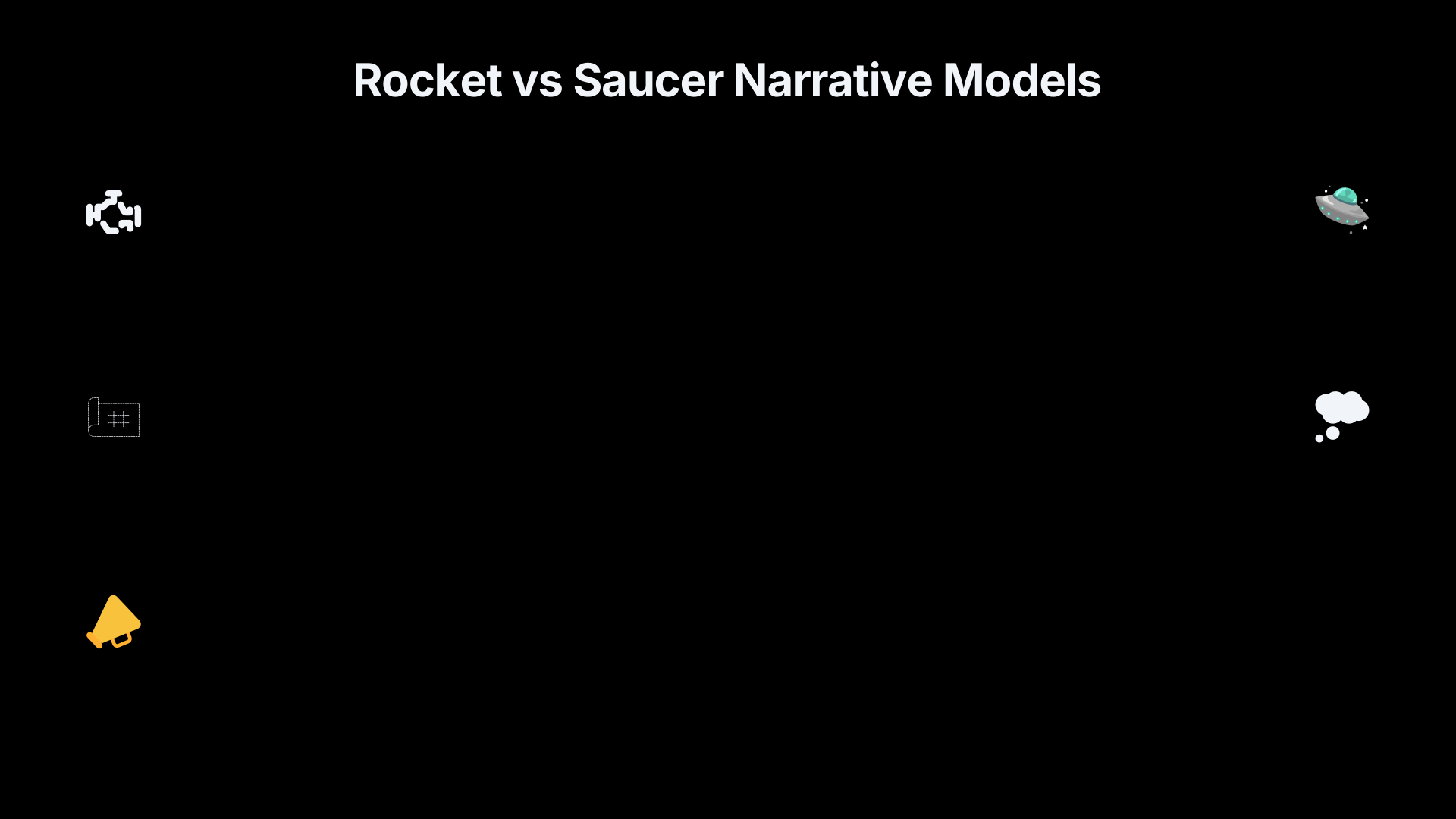
The shift from “ghost rockets” to “flying saucers” did not erase the rocket frame. It added a competing image. Rockets suggested directed, projectile-like flight: a missile, test vehicle or weapon. Saucers suggested manoeuvrability, hovering, silence and perhaps anti-gravity. Together they created two different models of the advanced UFO.
The rocket model was close to known engineering. It had exhaust, trajectory, launch sites, military users and strategic implications. It made UFOs seem like part of the missile age. The saucer model was more radically science-fictional. It implied a craft that might not need wings or conventional propulsion at all. That is why the flying saucer could so easily become a symbol of alien technology: it looked less like a better rocket and more like a different physics.
Yet the saucer still depended on the credibility that rockets had helped create. Once the public had accepted that technology could leap forward dramatically, a disc-shaped craft no longer had to be understood only as fantasy. It could be imagined as the next leap. In that sense, rockets did not simply compete with flying saucers as explanations; they prepared the cultural ground on which saucers could seem possible.
This distinction also shaped science fiction. Stories about rockets often emphasised exploration, engineering, launch crews and planetary destinations. Stories about saucers often emphasised visitation, surveillance, invasion, abduction or superior intelligence. UFO culture borrowed both. A sighting could be framed as a secret test vehicle, but the same report could also be absorbed into a story of visitors watching Earth from above.
Secret aircraft kept the UFO-tech link alive
The relationship between real technology and UFO imagination did not end with the 1940s. In the Cold War, classified aircraft repeatedly reinforced the idea that strange sightings might be human-made machines hidden behind official silence. The U-2, A-12 and OXCART programmes are especially important because they show the pattern in documented form: a real secret aircraft flies at unusual altitudes or with unusual performance; observers report something strange; investigators may know more than they can publicly say.
The National Security Archive’s account of the U-2 and Area 51 highlights how declassified CIA histories later confirmed details about secret reconnaissance programmes, including Groom Lake references and U-2 operations. Those revelations matter culturally because they validated part of the UFO imagination without validating the extraterrestrial claim: yes, governments really did hide exotic-looking aerospace projects; no, that did not mean the objects were alien spacecraft.[National Security Archive]nsarchive2.gwu.eduNational Security Archive The Secret History of the U-2National Security Archive The Secret History of the U-2
This pattern also helps explain why sceptical and believer interpretations often talk past each other. A sceptic may point out that many sightings have conventional or classified explanations. A believer may answer that secrecy itself is part of the pattern. Both responses draw energy from the same post-war fact: advanced aerospace technology has often been unevenly visible. Some people knew; most people did not; the sky occasionally revealed hints before official disclosure caught up.
The Pentagon’s All-domain Anomaly Resolution Office made a similar distinction in its 2024 historical report, assessing that alleged hidden alien reverse-engineering programmes were either unsupported, misidentified sensitive national-security programmes, or otherwise not evidence of extraterrestrial technology. That finding does not remove the cultural link between secrecy and UFOs. It underlines it: real classified programmes can be mistaken for more extraordinary things.[U.S. Department of War]media.defense.govDOPSR 2024 0263 AARO HISTORICAL RECORD REPORT VOLUMEDOPSR 2024 0263 AARO HISTORICAL RECORD REPORT VOLUME
The science-fiction feedback loop became more technical
Rockets and real aircraft did not replace imagination; they upgraded it. UFO stories after the war often sounded more technical than older sky mysteries. They referred to propulsion, radiation, radar, metals, trajectories, acceleration, military bases, launch sites and classified research. Even when claims were speculative or unsupported, they borrowed the vocabulary of real engineering.
This mattered for science fiction too. Writers and filmmakers could now build stories around recognisable technological anxieties: missiles arriving without warning, radar screens detecting unknown objects, saucers defeating jets, aliens observing nuclear tests, or governments hiding captured craft in military facilities. The plausibility did not come from proof. It came from resemblance. The fictional unknown resembled the real unknowns created by rapid technological change.
The same resemblance also affected witness interpretation. A light, shape or movement was not experienced in a cultural vacuum. If people knew about rockets, jet aircraft, satellites, missiles or secret test ranges, those ideas became part of the mental toolkit for describing the unexplained. NASA’s 2023 UAP report makes the modern version of this problem clear: observations that cannot immediately be identified as balloons, aircraft or known natural phenomena may remain unresolved when the data are poor, but unresolved does not automatically mean extraordinary.[NASA Science]science.nasa.govOpen source on nasa.gov.
That point is central to the science-fiction relationship. Fiction thrives in the gap between what is seen and what is known. Real technology widened that gap. The public could see enough to believe that astonishing machines existed, but not always enough to identify them. UFO imagination grew in that space.
What rockets changed most
The deepest change was not a single UFO shape or a single famous case. It was a new rule of imagination: the future might already be flying overhead.
Rockets taught the public that yesterday’s science fiction could become today’s military hardware. Secret aircraft taught the public that not all advanced machines would be announced when they first appeared. Spaceflight taught the public that Earth was no longer imaginatively sealed off from the wider cosmos. Together, these developments made UFOs feel like signs of a future arriving unevenly, whether that future was human, alien, or simply misunderstood.
That is why rockets belong at the centre of this subtopic. They made science-fictional UFO stories feel newly possible not because they proved alien visitation, but because they changed the public sense of technological limits. After the V-2, the jet age, classified reconnaissance aircraft and the coming Space Age, a strange object in the sky could plausibly be read as a machine ahead of ordinary knowledge. UFO culture and science fiction both grew from that altered horizon.
Amazon book picks
Further Reading
Books and field guides related to How Real Rockets Changed UFO Imagination. Use these as the next step if you want deeper reading beyond the article.
The Right Stuff
Rating: 4.5/5 from 8 Google Books ratings
Captures the cultural impact of advanced aerospace technology.
eBay marketplace picks
Marketplace Samples
Example marketplace items related to this page. Use the search link to explore similar finds on eBay.


Endnotes
1.
Source: cia.gov
Link:https://www.cia.gov/readingroom/docs/1946-08-23.pdf
2.
Source: history.navy.mil
Title: u2s ufos and operation blue book
Link:https://www.history.navy.mil/browse-by-topic/disasters-and-phenomena/u2s-ufos-and-operation-blue-book.html
3.
Source: archives.gov
Title: National Archives Project BLUE BOOK
Link:https://www.archives.gov/research/military/air-force/ufos
4.
Source: science.nasa.gov
Link:https://science.nasa.gov/wp-content/uploads/2023/09/uap-independent-study-team-final-report.pdf
5.
Source: archives.gov
Link:https://www.archives.gov/files/declassification/iscap/pdf/2014-004-doc01.pdf
6.
Source: history.com
Title: of UFOs
Link:https://www.history.com/articles/history-of-ufos
7.
Source: science.nasa.gov
Link:https://science.nasa.gov/uap/
8.
Source: science.nasa.gov
Link:https://science.nasa.gov/uap/faqs/
9.
Source: cia.gov
Link:https://www.cia.gov/readingroom/docs/DOC_0000192682.pdf
10.
Source: cia.gov
Link:https://www.cia.gov/readingroom/document/cia-rdp80b01676r004000110001-7
11.
Source: cia.gov
Link:https://www.cia.gov/readingroom/document/cia-rdp81r00560r000100010002-9
12.
Source: war.gov
Title: DOW UAP D077 Unresolved Case Analysis Update Western United States Event
Link:https://www.war.gov/medialink/ufo/061226/release_03/documents/DOW-UAP-D077_Unresolved-Case-Analysis-Update_Western-United-States-Event.pdf
13.
Source: airandspace.si.edu
Link:https://airandspace.si.edu/collection-objects/missile-surface-surface-v-2-4/nasm_A19600342000
Source snippet
National Air and Space MuseumV-2 MissileThe German V-2 rocket was the world's first large-scale liquid-propellant rocket vehicle, the fir...
14.
Source: Wikipedia
Title: Ghost rockets
Link:https://en.wikipedia.org/wiki/Ghost_rockets
15.
Source: tile.loc.gov
Link:https://tile.loc.gov/storage-services/master/gdc/gdcebookspublic/20/20/71/54/77/2020715477/2020715477.pdf
16.
Source: airandspace.si.edu
Title: restoring museums v 2 missile
Link:https://airandspace.si.edu/stories/editorial/restoring-museums-v-2-missile
17.
Source: classicsofsciencefiction.com
Title: the 1953 sff magazine boom
Link:https://classicsofsciencefiction.com/2022/05/13/the-1953-sff-magazine-boom/
18.
Source: nsarchive2.gwu.edu
Title: National Security Archive The Secret History of the U-2
Link:https://nsarchive2.gwu.edu/NSAEBB/NSAEBB434/
19.
Source: media.defense.gov
Title: DOPSR 2024 0263 AARO HISTORICAL RECORD REPORT VOLUME 1 2024
Link:https://media.defense.gov/2024/Mar/08/2003409233/-1/-1/0/DOPSR-2024-0263-AARO-HISTORICAL-RECORD-REPORT-VOLUME-1-2024.PDF
20.
Source: Wikipedia
Title: Area 51
Link:https://en.wikipedia.org/wiki/Area_51
21.
Source: Wikipedia
Title: Project Blue Book
Link:https://en.wikipedia.org/wiki/Project_Blue_Book
22.
Source: aaro.mil
Title: AARO Historical Record Report Vol 1 2024
Link:https://www.aaro.mil/Portals/136/PDFs/AARO_Historical_Record_Report_Vol_1_2024.pdf
23.
Source: aaro.mil
Link:https://www.aaro.mil/Portals/136/PDFs/Information%20Papers/AARO_Declassification_Info_Paper_2025.pdf
24.
Source: aaro.mil
Title: Case Resolution of Eglin UAP 2 508
Link:https://www.aaro.mil/portals/136/PDFs/case_resolution_reports/Case_Resolution_of_Eglin_UAP_2508.pdf
25.
Source: airandspace.si.edu
Title: military rockets launched space age
Link:https://airandspace.si.edu/stories/editorial/military-rockets-launched-space-age
26.
Source: facebook.com
Link:https://www.facebook.com/airandspace/posts/one-of-the-icons-of-the-museum-was-the-black-and-white-german-v-2-ballistic-miss/693306022832809/
27.
Source: nationalarchives.gov.uk
Link:https://www.nationalarchives.gov.uk/explore-the-collection/explore-by-time-period/postwar/ufo-reports/
28.
Source: dbrl.bibliocommons.com
Link:https://dbrl.bibliocommons.com/v2/list/display/70717366/72282639
29.
Source: abcnews.com
Link:https://abcnews.com/US/area-51-revealed-cia-spy-plane-documents/story?id=19977635
Additional References
30.
Source: youtube.com
Link:https://www.youtube.com/watch?v=0PcRWdWO3Os
Source snippet
Ultimate 1950s Flying Saucer, UFO, and Alien Encounter Movies...
31.
Source: youtube.com
Title: How did the V2 rocket launch the Space Age?
Link:https://www.youtube.com/watch?v=vr1A5Ta4rD8
Source snippet
The Secret WWII Rocket Program That Birthed the Space Age. Forging the Frontiers of Flight...
32.
Source: nsa.gov
Link:https://www.nsa.gov/portals/75/documents/news-features/declassified-documents/ufo/usaf_fact_sheet_95_03.pdf
33.
Source: facebook.com
Link:https://www.facebook.com/GerryAndersonOfficial/posts/dont-panic-alec-ufo-star-george-sewell-was-born-100-years-ago-today/907521921410264/
34.
Source: researchgate.net
Link:https://www.researchgate.net/publication/304652761_A_Ghost_in_the_Machine_How_Sociology_Tried_to_Explain_Away_American_Flying_Saucers_and_European_Ghost_Rockets
35.
Source: sfu.ca
Link:https://www.sfu.ca/~andrewf/books/An_End_to_History_Science_Fiction.pdf
36.
Source: amazon.co.uk
Link:https://www.amazon.co.uk/Estimate-Situation-[Unidentified
37.
Source: ebsco.com
Link:https://www.ebsco.com/research-starters/history/golden-age-american-science-fiction
38.
Source: reddit.com
Link:https://www.reddit.com/r/area51/comments/1ollc9r/help_needed_on_u2_research/
39.
Source: reddit.com
Link:https://www.reddit.com/r/Futurology/comments/16ijwyl/nasa_shares_unidentified_anomalous_phenomena/
Topic Tree