Within Radar Reports
Why the Go Fast UFO video misled viewers
The Go Fast case shows how compressed video without original metadata can look dramatic but remain difficult to measure rigorously.
On this page
- What the public video appeared to show
- What AARO said was missing from the evidence
- How compression and geometry affect interpretation
Page outline Jump by section
Introduction
The Go Fast video became one of the most famous pieces of modern military UFO footage because it seemed to show an object racing just above the ocean at extraordinary speed. Released publicly after being recorded by a US Navy F/A-18 aircraft in 2015, the clip quickly entered popular culture, where it was often presented as visual proof of something beyond conventional explanation. Yet the case ultimately illustrates a more important lesson about the machine-witness problem: dramatic footage can be far less informative than it appears when crucial sensor data and metadata are missing.
 Within debates about UFOs and science fiction, Go Fast is significant because it looks like the kind of impossible aerial pursuit long familiar from fiction. The public video seems to show an object outrunning ordinary expectations. However, subsequent technical analysis focused less on what the clip appeared to show and more on what could actually be measured from the available evidence. That distinction reveals why public footage alone often cannot settle extraordinary claims.[AARO]aaro.milGo Fast Case Resolution Card Methodology FinalUNCLASSIFIEDMay 10, 2026…
What the public video appeared to show
The publicly released footage shows an infrared targeting display tracking a small object over the ocean. To many viewers, the most striking feature is the apparent speed. The object seems to skim close to the water while crossing the field of view rapidly enough to suggest advanced propulsion or unusual manoeuvrability.
Part of the video’s cultural impact came from its military origin. Unlike many UFO videos circulating online, Go Fast came from a sophisticated military sensor system aboard a combat aircraft. The display overlays, pilot reactions and official release by the US Department of Defense gave the footage an aura of technical credibility that distinguished it from amateur recordings.[WHDH 7News]whdh.com7News Pentagon releases 3 ‘unidentified aerial phenomena’ videosWHDH 7NewsPentagon releases 3 ‘unidentified aerial phenomena’ videos - Boston News, Weather, Sports | WHDH 7NewsApril 27, 2020…
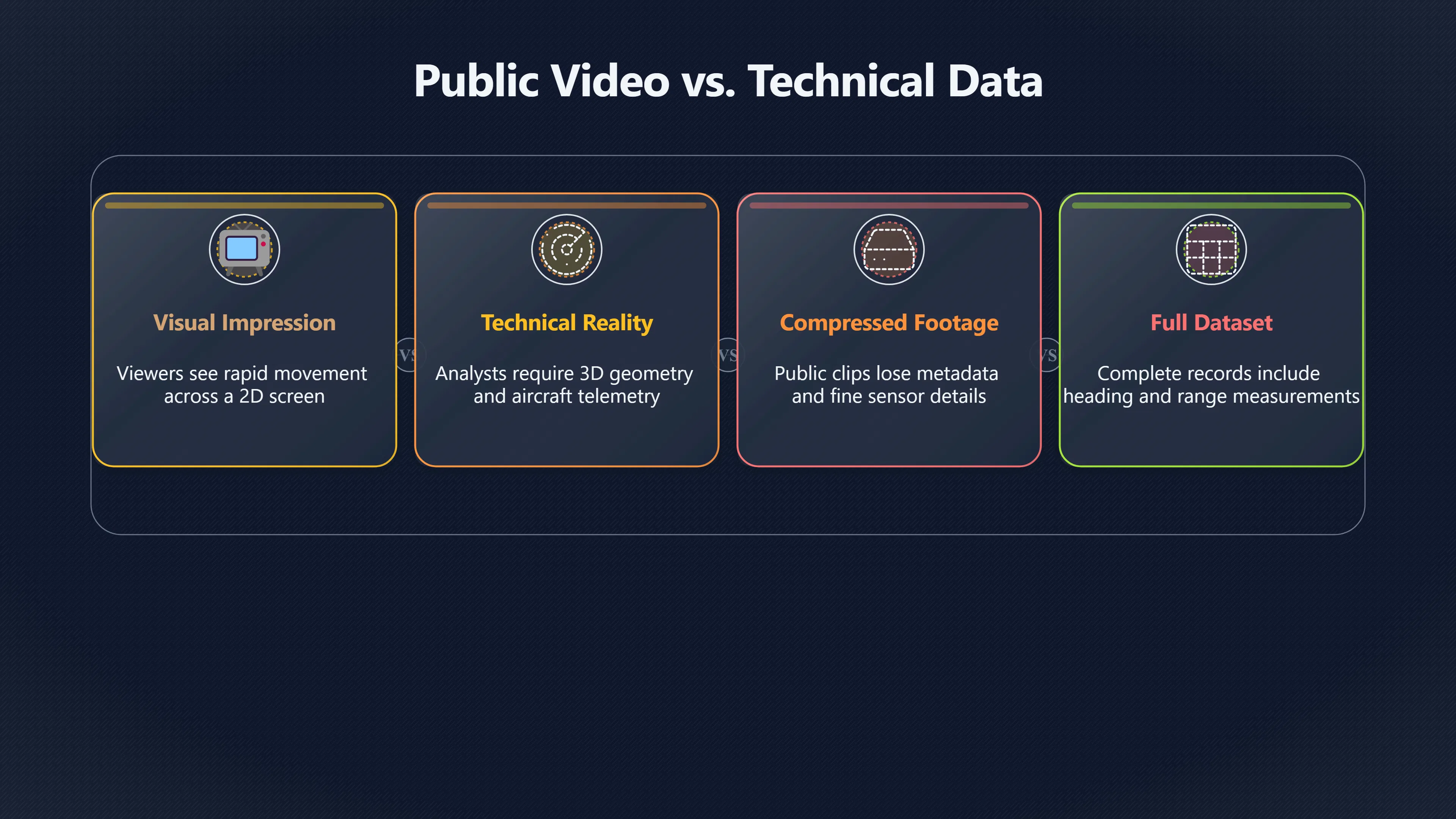
For audiences already familiar with science-fiction imagery of mysterious craft, the clip appeared to provide something more concrete than eyewitness testimony. The object seemed to be captured by a machine rather than merely observed by a person. Yet the public video was never the complete dataset. It was a compressed extract from a much larger chain of sensor observations and aircraft information.
What AARO said was missing from the evidence
A central issue in later analysis was that the publicly available footage lacked much of the information needed for precise reconstruction. The Pentagon’s All-domain Anomaly Resolution Office (AARO) stated that high-confidence determination of the object’s exact position was not possible because analysts lacked sufficiently precise positional information from the observing aircraft.[AARO]aaro.milMission BriefAARO Mission Brief…
This limitation matters because apparent motion in a video depends on far more than the object’s own movement. Analysts need detailed information about:
- The aircraft’s exact position and heading.
- Aircraft speed and manoeuvres during the observation.
- Sensor orientation and tracking behaviour.
- Range measurements and their uncertainties.
- Original recording quality rather than publicly released compressed footage.
Without those elements, observers can estimate possibilities but cannot fully reconstruct the geometry of the encounter. AARO’s assessment emphasised that missing positional information constrained what could be determined with certainty even while supporting broader conclusions about the object’s likely behaviour.[AARO]aaro.milMission BriefAARO Mission Brief…
The gap between public footage and complete sensor records is a recurring problem in UFO investigations. Viewers often assume they are seeing the entire evidential record when in reality they are seeing a selected visual product detached from much of the technical context that originally accompanied it.

How compression and geometry affect interpretation
Why apparent speed can be deceptive
The most important technical concept in the Go Fast debate is motion parallax. Motion parallax occurs when an observer moves rapidly relative to a distant object. Under some viewing geometries, a stationary or slow-moving object can appear to sweep across the background at remarkable speed.
AARO’s analysis concluded that the object’s apparently dramatic motion could be explained by this effect. According to its assessment, the object’s actual speed was consistent with movement comparable to prevailing winds at altitude rather than with extraordinary performance. The office estimated possible speeds roughly between 5 and 92 miles per hour and concluded that the object did not exhibit anomalous flight characteristics.[AARO]aaro.milGo Fast Case Resolution Card Methodology FinalUNCLASSIFIEDMay 10, 2026…
The key point is that a two-dimensional video frame does not directly reveal three-dimensional motion. Viewers naturally interpret movement across the screen as movement through space, but the relationship between those two things depends on distance, angle and observer motion.
Why compressed public footage has limits
The public version of Go Fast was never intended as a scientific dataset. It was a distributable video clip. Compression removes information to reduce file size, and any public release may omit technical details that analysts would ideally want to examine. More generally, video researchers note that compression and processing can introduce artefacts or obscure fine details that would otherwise aid analysis.[arXiv]arxiv.orgarXiv BVI-Artefact: An Artefact Detection Benchmark Dataset for Streamed VideosBVI-Artefact: An Artefact Detection Benchmark Dataset for Streamed VideosDecember 14, 2023…
Metadata is equally important. In many forms of technical and forensic analysis, provenance information helps establish how a recording was created, what equipment produced it and what contextual information accompanies it. When viewers have access only to a public clip, much of that evidential framework is absent.[AIVideoDetector]aivideodetector.comWhat Do AI Detectors Look For to Spot Deepfakes | AI Video DetectorMarch 9, 2026…
For the Go Fast case, this meant that public debate often centred on visual impressions, while professional analysis depended on additional information about aircraft systems, environmental conditions and sensor geometry.
What the case reveals about machine witnesses
Go Fast demonstrates that sensor footage is neither simple proof nor simple illusion. The recording came from a sophisticated military system, yet interpreting it still required assumptions about geometry, range and aircraft motion. The machine witnessed something real, but understanding what the machine witnessed proved far more difficult than many viewers initially assumed.
This is precisely where UFO discussions intersect with science fiction. Popular culture often imagines advanced sensors as devices that reveal reality with perfect clarity. The Go Fast case suggests a more complicated reality. Sensors extend human perception, but they also create new layers of interpretation. A video can look astonishing while remaining difficult to measure rigorously.
The enduring importance of Go Fast is therefore not that it conclusively proved or disproved an extraordinary object. Its value lies in showing how a widely circulated clip can become a symbol of mystery while simultaneously demonstrating the limits of public footage. The closer analysts looked at the available evidence, the more the debate turned away from what seemed obvious on screen and toward the missing data needed to understand what the screen actually showed.[AARO]aaro.milGo Fast Case Resolution Card Methodology FinalUNCLASSIFIEDMay 10, 2026…
Amazon book picks
Further Reading
Books and field guides related to Why the Go Fast UFO video misled viewers. Use these as the next step if you want deeper reading beyond the article.

UFOs : Generals, Pilots, and Government Officials Go on the R...
Covers military encounters and evidence debates relevant to Go Fast.
The Report on Unidentified Flying Objects
Provides historical context for official investigation of aerial anomalies.
The Demon-Haunted World
Rating: 4.5/5 from 43 Google Books ratings
Highlights the need for complete data before extraordinary conclusions.
eBay marketplace picks
Marketplace Samples
Live-tested eBay searches with available results related to this page.




Endnotes
1.
Source: aaro.mil
Title: Go Fast Case Resolution Card Methodology Final
Link:https://www.aaro.mil/Portals/136/PDFs/case_resolution_reports/AARO_GoFast_Case_Resolution_Card_Methodology_Final.pdf?ver=qXvjrruO_0MgtnTsfYnCEQ%3D%3D
Source snippet
UNCLASSIFIEDMay 10, 2026...
Published: May 10, 2026
2.
Source: aaro.mil
Title: Mission Brief
Link:https://www.aaro.mil/Portals/136/PDFs/AARO_Mission_Brief_2025.pdf
Source snippet
AARO Mission Brief...
3.
Source: whdh.com
Title: 7News Pentagon releases 3 ‘[unidentified]({{ ‘unidentified/’ | relative_url }}) aerial phenomena’ videos
Link:https://whdh.com/news/pentagon-releases-3-unidentified-aerial-phenomena-videos/
Source snippet
WHDH 7NewsPentagon releases 3 ‘unidentified aerial phenomena’ videos - Boston News, Weather, Sports | WHDH 7NewsApril 27, 2020...
Published: April 27, 2020
4.
Source: arxiv.org
Title: arXiv BVI-Artefact: An Artefact Detection Benchmark Dataset for Streamed Videos
Link:https://arxiv.org/abs/2312.08859
Source snippet
BVI-Artefact: An Artefact Detection Benchmark Dataset for Streamed VideosDecember 14, 2023...
Published: December 14, 2023
5.
Source: aivideodetector.com
Link:https://www.aivideodetector.com/blog/what-do-ai-detectors-look-for
Source snippet
What Do AI Detectors Look For to Spot Deepfakes | AI Video DetectorMarch 9, 2026...
Published: March 9, 2026
Additional References
6.
Source: youtube.com
Link:http://www.youtube.com/watch?v=mvsU4p0Gsas
Source snippet
The GoFast UFO Was “Debunked”—Until You Look at the Data...
7.
Source: redactor.com
Title: How Courts Determine if Audio or Video is Authentic
Link:https://www.redactor.com/blog/how-courts-determine-audio-video-evidence-authenticity
Source snippet
How Courts Determine if Audio or Video is Authentic...
8.
Source: youtube.com
Title: The Go Fast UFO Was “Debunked”—Until You Look at the Data
Link:http://www.youtube.com/watch?v=TDKMNqg2BO8
Source snippet
"Tic Tac" UFO | Are They Real? |David Fravor's Testimony...
9.
Source: youtube.com
Title: Elon Musk
Link:http://www.youtube.com/watch?v=n084vs6NuIs
Source snippet
Go Fast UAP video technical analysis parallax The Best UFO Footage Ever Mindlab...
10.
Source: youtube.com
Title: “Tic Tac” UFO | Are They Real? |David Fravor’s Testimony
Link:http://www.youtube.com/watch?v=xWczM1_RPsU
Source snippet
The Best UFO Footage Ever...
11.
Source: youtube.com
Title: The Best UFO Footage Ever
Link:http://www.youtube.com/watch?v=MftWg1BVGP8
Source snippet
Elon Musk - Tic Tac UFO counter...
Topic Tree