Relationships betwee
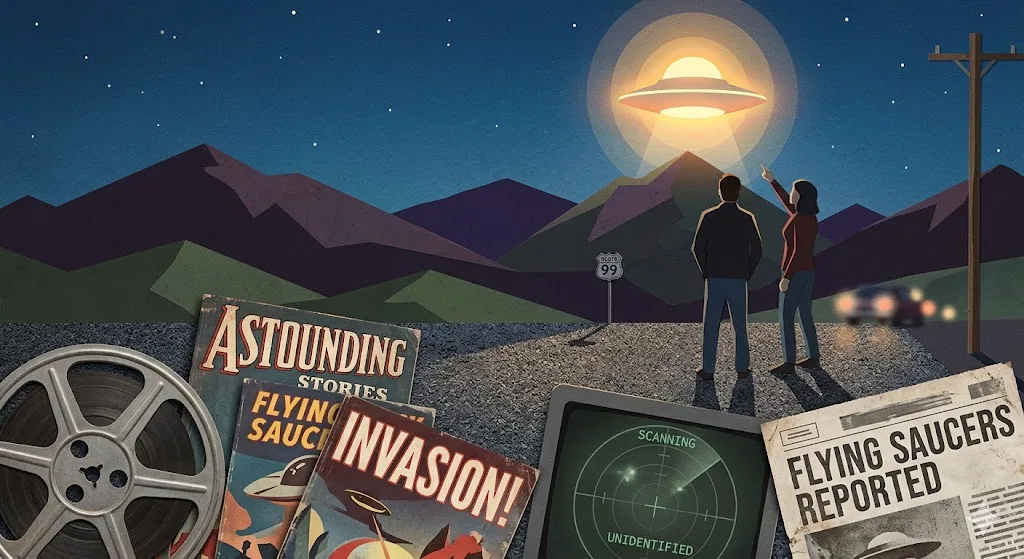
UFOs and science fiction have never been the same thing, but they have shaped each other for more than a century. A UFO is simply an unidentified flying object or, in newer official language, an unidentified anomalous phenomenon; science fiction is a genre of imaginative storytelling.
Page outline Jump by section
Introduction
The best-supported view is not that science fiction “invented” UFOs, nor that UFO reports prove science fiction correct. It is that the two form a feedback loop: unusual sky reports feed fiction, fiction supplies images and expectations, and those images then influence later testimony, media coverage and public belief. Official investigations have repeatedly found unresolved cases but no verified evidence that UFOs are extraterrestrial craft, while cultural historians and folklorists have shown that UFO stories behave like modern myths shaped by the technologies, fears and hopes of their time.[archives.gov]archives.govNational ArchivesProject BLUE BOOK - Unidentified Flying ObjectsAugust 15, 2016 — From 1947 to 1969, a total of 12, 618 sightings were re…
Why UFOs quickly became a science-fiction story
The modern UFO era began in 1947, when pilot Kenneth Arnold reported seeing fast-moving objects near Mount Rainier. The phrase “flying saucer” became attached to the story through press coverage, even though Arnold’s own descriptions were more complex than a simple saucer shape. The Smithsonian’s National Air and Space Museum notes that Arnold later drew a form closer to a rounded, heel-like craft, while Britannica summarises the familiar point: a newspaper description helped turn the report into the “flying saucer” image that spread through public culture.[National Air and Space Museum]airandspace.si.edu1947 year flying saucer1947 year flying saucer
That timing was crucial. The Second World War had just ended, rockets had become real weapons, atomic power had transformed public ideas of science, and the Cold War was beginning. Science fiction already offered readers images of space travel, alien civilisations, secret weapons and future war. When UFO reports entered the news, audiences did not receive them as neutral observations. They arrived in a world already trained to imagine the sky as a military frontier, a scientific frontier and a possible route for visitors from elsewhere.
The Library of Congress captures the link well: in the 1940s and 1950s, reports of flying saucers became a cultural phenomenon and supplied Hollywood with material for visions of possible threat. The same source connects saucers to older ideas about life on the Moon, canals on Mars and Martian civilisation, while also noting that Cold War fears made the image of hidden visitors especially powerful.[The Library of Congress]loc.govIn the 1940s and 50s reports of "flying saucers… Carl Sagan suggests that stories of alien abduction are primarily part of American…
This is why UFO history cannot be separated from science fiction, even when individual reports may have ordinary, military, atmospheric or unresolved explanations. A light in the sky becomes culturally meaningful when people ask: is it a secret aircraft, an alien probe, a warning, a hoax, a sign of invasion, or evidence of government concealment? Those are not purely observational questions. They are narrative questions, and science fiction had already built many of the available narratives.
The feedback loop: sightings feed stories, stories shape sightings
The relationship between UFOs and science fiction works in both directions. Real reports have inspired fiction, but fictional conventions have also shaped what witnesses, journalists and audiences expect a UFO to look like.
Early flying saucer reports emphasised speed, mystery and manoeuvrability. Later popular images settled into a more standard visual language: a disc, a dome, lights, hovering motion, silent movement, beams, occupants and sometimes abduction. Not every witness uses that vocabulary, and reported shapes vary widely, but the cultural “default UFO” became recognisable enough that an artist can build a man-made saucer and audiences immediately know what it is meant to evoke. A Wired piece on artist Peter Coffin’s constructed UFO makes this point by observing that, although a UFO should by definition be unidentified, popular culture has taught people to “identify” the idea as a saucer-like object with lights.[WIRED]wired.comBuilding the Unbuildable: What Happens When We're the Ones Flying UFOs?Building the Unbuildable: What Happens When We're the Ones Flying UFOs?
Science fiction did not create all of those ingredients from nothing. It borrowed from earlier folklore, religion, astronomy, military secrecy, airship panics, ghost stories and colonial invasion literature. But it gave the ingredients a modern technological skin. Fairies, angels, demons, sky gods and phantom airships became astronauts, greys, reptilians, motherships and interdimensional craft. That is one reason scholars such as Carl Jung and later Jacques Vallée became interested in UFOs not only as possible physical events but also as symbolic events: stories about the sky that reveal what a society is trying to process. Jung’s Flying Saucers: A Modern Myth of Things Seen in the Skies treated UFOs as “visionary rumours” and a modern myth rather than simply as hardware claims; Vallée’s Passport to Magonia is widely known for connecting UFO encounters with older folklore patterns.[Routledge]routledge.comOpen source on routledge.com.
The feedback loop can be simplified like this:
- A sighting occurs. It may be a planet, aircraft, balloon, meteor, sensor artefact, classified technology, hoax or genuinely unresolved case.
- The report enters public language. Journalists, investigators and witnesses use available terms such as “saucer”, “craft”, “orb”, “mothership” or “drone”.
- Fiction absorbs the report. Films, novels and television turn the uncertainty into narrative: invasion, contact, abduction, cover-up, enlightenment or apocalypse.
- Later witnesses inherit the imagery. Even sincere observers may describe ambiguous events through familiar fictional and media templates.
- The cycle repeats. New reports appear to confirm the imagery that earlier stories popularised.
This does not mean witnesses are lying. It means perception, memory and narration are social as well as individual. People describe the unknown using the nearest available cultural tools.

Science fiction gave UFOs their emotional range
One reason UFOs remain powerful is that science fiction gave them more than one emotional meaning. A UFO can be frightening, hopeful, absurd, spiritual, bureaucratic, comic or sublime. That flexibility helps explain why the subject survives changes in technology and sceptical critique.
In 1950s cinema, flying saucers often carried invasion anxieties. Films such as Earth vs. the Flying Saucers turned the saucer into a Cold War threat: an unknown technology violating national airspace and challenging human control. The Library of Congress explicitly connects these mid-century portrayals with fears created by atomic weapons and the uncertain promise of technology.[The Library of Congress]loc.govIn the 1940s and 50s reports of "flying saucers… Carl Sagan suggests that stories of alien abduction are primarily part of American…
By contrast, later science fiction could make visitors benevolent, misunderstood or spiritually advanced. The emotional distance between The War of the Worlds, The Day the Earth Stood Still, Close Encounters of the Third Kind, E.T. and The X-Files is enormous, yet all draw from the same reservoir of sky mystery, contact and uncertainty. A psychological reading of alien films published through the US National Library of Medicine notes that Cold War dreams were haunted by nuclear annihilation, while alien stories could stage conflicts involving both benign and malevolent outsiders.[PMC]pmc.ncbi.nlm.nih.govOpen source on nih.gov.
That range matters because it helps explain why UFO belief is not a single belief. For some people, UFOs imply invasion. For others, rescue. For others, government deception. For others, the possibility that humanity is not alone. Science fiction keeps all these possibilities available at once, allowing UFOs to function as a screen onto which different audiences project different concerns.
Government secrecy made the fiction feel plausible
UFO stories became especially durable because they developed alongside real secrecy. The Cold War produced classified aircraft, nuclear testing, radar systems, intelligence agencies and official investigations. It was therefore not irrational for the public to suspect that governments knew more about some aerial events than they disclosed. The problem is that reasonable suspicion easily blended with science-fictional expectation: hidden hangars, crashed saucers, reverse-engineered alien craft, erased witnesses and secret contact programmes.
The US Air Force’s Project Blue Book is central here. According to the National Archives and the US Air Force, 12,618 sightings were reported from 1947 to 1969, with 701 remaining “unidentified” when the project ended. The official conclusion was not that 701 alien craft had been found; rather, the unresolved category reflected cases that could not be confidently identified from the available evidence.[National Archives]archives.govNational ArchivesProject BLUE BOOK - Unidentified Flying ObjectsAugust 15, 2016 — From 1947 to 1969, a total of 12, 618 sightings were re…
The CIA’s historical materials also show that officials worried about public reaction. The Robertson Panel, convened in 1953, considered the possibility that UFO reports could contribute to mass hysteria or be exploited for psychological warfare. That concern illustrates a key feature of the UFO-science fiction relationship: governments were not merely investigating strange objects; they were also managing stories, rumours and public interpretation.[CIA]cia.govOpen source on cia.gov.
Recent official reporting has kept this tension alive. NASA’s 2023 independent study found no conclusive evidence in the peer-reviewed literature for an extraterrestrial origin of UAP, while arguing that better data, better sensors and reduced stigma are needed. The US All-domain Anomaly Resolution Office reported in 2024 that it had found no verifiable evidence that any UAP sighting represented extraterrestrial activity or that the US government had possessed extraterrestrial technology.[NASA Science]science.nasa.govNASA ScienceIndependent Study Team ReportTo date, in the peer-reviewed scientific literature, there is no conclusive evidence suggesting…
Yet unresolved cases, redactions and bureaucratic language still leave imaginative space. Science fiction thrives in that space. A file saying “unidentified” is not the same as a file saying “alien”, but popular storytelling often moves quickly from the first word to the second.
The abduction narrative shows the strongest overlap
The clearest overlap between UFO lore and science fiction is the alien abduction story. The common pattern is familiar: a person is taken aboard a craft, examined by non-human beings, subjected to medical or reproductive procedures, shown warnings about humanity, then returned with missing time or fragmented memory. This structure feels modern because it uses spacecraft, laboratories and aliens, but its deeper shape resembles older encounter traditions: journeys to another realm, strange beings, altered time, bodily marks, forbidden knowledge and return.
The Library of Congress notes Carl Sagan’s view that alien abduction stories are primarily part of American culture, and its Sagan materials preserve his interest in the way popular UFO claims spread through magazines, books and interviews.[The Library of Congress]loc.govIn the 1940s and 50s reports of "flying saucers… Carl Sagan suggests that stories of alien abduction are primarily part of American…
Science fiction did not simply copy abduction lore after the fact. It helped normalise many of its images: the examination room, the small humanoid alien, the bright beam, the telepathic message, the silent craft. At the same time, abduction claims fed films and television. The result is a particularly tight cultural loop in which personal testimony and fictional representation reinforce each other.
This is why abduction narratives are difficult to discuss well. Treating every account as deliberate fabrication is too crude; treating every account as literal alien contact goes far beyond the evidence. The more useful approach is to ask how memory, trauma, sleep paralysis, hypnosis, religious experience, media exposure, expectation and community reinforcement can interact. That question sits exactly at the boundary between UFO studies, psychology, folklore and science fiction.
Science fiction also shaped scepticism
The relationship does not only help believers. Science fiction has also shaped sceptical interpretation. When a UFO claim resembles a known film, television episode or pulp motif, sceptics often treat that resemblance as evidence of cultural borrowing. This is sometimes persuasive, especially when the details appear after a famous depiction enters circulation. But it can also be too simple, because fiction and testimony may draw on older shared motifs rather than one directly copying the other.
For example, the idea of a crashed craft with strange bodies is older than Roswell as a cultural motif. Research by David Clarke on UFOs and popular culture points to nineteenth-century newspaper inventions about extraterrestrial airships crashing in remote places, sometimes with Martian bodies and mysterious writing. Clarke also notes that post-war fiction revived related motifs, including Bernard Newman’s 1948 novel The Flying Saucer, in which scientists use a saucer deception to address fears of another world war.[SHURA]shura.shu.ac.ukSHURAI want to believe: how UFOs conquered the X-filesSHURAI want to believe: how UFOs conquered the X-files
This complicates the usual debate. A similarity between a UFO claim and a science-fiction plot does not automatically prove fraud, but it does show that the story belongs to a long imaginative tradition. The more specific and datable the overlap, the stronger the case for cultural influence. The more general the overlap, the more likely it is that both the claim and the fiction draw from older mythic material.
Scepticism itself can become formulaic if it treats culture as a one-way contamination of evidence. The better question is not “Did fiction contaminate UFOs?” but “Which parts of a report are observational, which are interpretive, and which are inherited from available story forms?”

Modern UAP research tries to separate data from story
The newer term UAP is partly an attempt to move away from the overloaded imagery of “UFO”. It broadens the category beyond flying objects and avoids immediate association with saucers and aliens. NASA’s independent study framed UAP as a data problem: many reports lack the calibrated, repeatable, multi-sensor information needed for confident explanation.[NASA Science]science.nasa.govNASA ScienceIndependent Study Team ReportTo date, in the peer-reviewed scientific literature, there is no conclusive evidence suggesting…
Recent scientific and academic work follows the same logic. A 2024 scoping review by Gretchen Stahlman describes UAP studies as a field moving from stigma towards a need for high-quality curated data and rigorous investigation. A 2025 review by Kevin Knuth and colleagues argues that UAP have been investigated by governments and private researchers across multiple countries, and that future study should draw on this longer documented history.[arXiv]arxiv.orgOpen source on arxiv.org.
This scientific turn does not erase the science-fiction connection. In fact, it makes the separation more important. Researchers need to distinguish instrument readings from witness interpretation, and unusual motion from assumptions about propulsion, intent or origin. A report of a fast object is a data claim. A claim that it is a piloted extraterrestrial craft is an explanatory leap. Science fiction often supplies the leap.
This is also why official language can frustrate the public. “Unresolved” sounds dramatic, but in scientific terms it may mean poor data, missing context, unavailable sensor calibration or an object too distant to identify. The most honest modern UAP research does not ask readers to abandon imagination; it asks them not to mistake imagination for evidence.
Fiction, folklore and belief are part of the evidence
For historians and folklorists, the cultural layer is not an embarrassment to be stripped away. It is part of what UFOs are. UFOs are reported events, media events, government events, belief events and entertainment events at the same time.
David Clarke’s work on British UFO culture, including his role as a consultant during the release of the UK Ministry of Defence UFO files, treats UFOs as contemporary legend as well as a matter of documents and sightings. The Folklore Society’s description of Clarke’s work on how UFOs “landed” in Britain stresses how the UFO myth became embedded in existing legends and beliefs, with photography and visual evidence playing important roles.[folklore-society.com]folklore-society.comFlying Saucery: How UFOs Landed in the British Isles1 Jul 2025 — This talk examines how the UFO myth first arrived in the British…
That folkloric approach explains why UFO stories remain memorable even when particular cases are explained. A solved sighting may lose evidential force but keep symbolic force. It can still become a local legend, a film scene, a conspiracy reference, a tourist attraction, a meme or a family story. Science fiction then recycles those fragments into new forms.
The 1977 British mockumentary Alternative 3 is a useful example of fiction leaking into conspiracy culture. Presented as a fictional episode of Science Report, it imagined secret elite evacuation to Mars amid environmental catastrophe. Decades later, as The Guardian reported in 2026, its themes of government secrecy, missing scientists and hidden colonisation still circulate in conspiracy contexts.[The Guardian]theguardian.comIts themes—government secrecy, scientist disappearances, and extraterrestrial colonization—have resurfaced recently in alarmist social me…
That case is not exactly a UFO sighting, but it belongs to the same cultural mechanism: a fictional media object becomes durable because it resembles anxieties people already have about secrecy, science, catastrophe and space.
Common myths about UFOs and science fiction
Several misunderstandings make the UFO-science fiction relationship harder to discuss clearly.
Myth 1: “UFO” means “alien spacecraft”.
It does not. A UFO is unidentified to the observer or investigator at a given point. Official US records contain unresolved cases, but unresolved is not the same as extraterrestrial. Project Blue Book left 701 cases unidentified, while later NASA and AARO reports found no conclusive or verifiable evidence of extraterrestrial origin.[archives.gov]archives.govNational ArchivesProject BLUE BOOK - Unidentified Flying ObjectsAugust 15, 2016 — From 1947 to 1969, a total of 12, 618 sightings were re…
Myth 2: science fiction simply invented UFO belief.
The relationship is older and more tangled. People reported strange lights, aerial ships and heavenly signs long before modern science fiction. What science fiction did was translate older wonder and fear into technological form: craft, pilots, laboratories, weapons, planets and advanced civilisations.
Myth 3: resemblance to fiction proves a witness is lying.
Cultural influence does not automatically equal fraud. Honest people use available images to describe ambiguous experiences. The challenge is to separate observation from interpretation: “I saw a silent light moving strangely” is different from “I saw an alien reconnaissance craft”.
Myth 4: official scepticism killed the subject.
It did not. Official scepticism sometimes increased suspicion, especially where secrecy, redaction or military technology were involved. Public interest persists partly because official investigations can say “no evidence of aliens” while still leaving some cases unexplained.
Myth 5: science fiction is only a source of error.
Science fiction can mislead when it encourages premature conclusions, but it also helps societies think through genuine questions: What would contact mean? How should institutions handle uncertainty? What does secrecy do to trust? How do humans react when ordinary categories fail?

What the relationship tells us about modern culture
The bond between UFOs and science fiction is strongest where technology outruns public understanding. Radar, rockets, nuclear weapons, satellites, stealth aircraft, drones, artificial intelligence and sensor networks all create gaps between what exists, what is classified, what is explainable and what ordinary people can recognise. Science fiction fills those gaps with story.
That does not make the subject trivial. UFOs are culturally important precisely because they sit at the intersection of evidence and imagination. They ask practical questions about airspace, sensor data and military transparency. They also ask human questions about loneliness, fear, wonder, distrust and the hope that the universe contains other minds.
The most useful way to understand UFOs and science fiction is therefore not as rivals, with one “real” and the other “fake”. They are intertwined systems for handling the unknown. UFO reports give science fiction new images of mystery. Science fiction gives UFO culture its shapes, motives and emotional scripts. Between them lies the hard work of investigation: identifying what was actually seen, what was inferred, what was remembered, what was borrowed, and what remains genuinely unknown.
Amazon book picks
Further Reading
Books and field guides related to When UFO Reports Became Modern Myth. Use these as the next step if you want deeper reading beyond the article.
The Report on Unidentified Flying Objects
Covers early official investigations that shaped UFO mythology.

UFOs : Generals, Pilots, and Government Officials Go on the R...
Explores how UFO reports are interpreted by institutions and the public.
eBay marketplace picks
Marketplace Samples
Example marketplace items related to this page. Use the search link to explore similar finds on eBay.



Endnotes
1.
Source: archives.gov
Link:https://www.archives.gov/research/military/air-force/ufos
Source snippet
National ArchivesProject BLUE BOOK - Unidentified Flying ObjectsAugust 15, 2016 — From 1947 to 1969, a total of 12, 618 sightings were re...
Published: August 15, 2016
2.
Source: science.nasa.gov
Link:https://science.nasa.gov/wp-content/uploads/2023/09/uap-independent-study-team-final-report.pdf
Source snippet
NASA ScienceIndependent Study Team ReportTo date, in the peer-reviewed scientific literature, there is no conclusive evidence suggesting...
3.
Source: folklore-society.com
Link:https://www.folklore-society.com/event/flying-saucery-how-ufos-landed-in-the-british-isles/
Source snippet
Flying Saucery: How UFOs Landed in the British Isles1 Jul 2025 — This talk examines how the UFO myth first arrived in the British...
4.
Source: britannica.com
Link:https://www.britannica.com/topic/unidentified-flying-object
5.
Source: wired.com
Title: Building the Unbuildable: What Happens When We’re the Ones Flying UFOs?
Link:https://www.wired.com/2013/09/sts-peter-coffin-ufo
6.
Source: routledge.com
Link:https://www.routledge.com/Flying-Saucers-A-Modern-Myth-of-Things-Seen-in-the-Sky/Jung/p/book/9780415278379
7.
Source: pmc.ncbi.nlm.nih.gov
Link:https://pmc.ncbi.nlm.nih.gov/articles/PMC7122918/
8.
Source: cia.gov
Link:https://www.cia.gov/readingroom/docs/CIA-RDP79B00752A000300100010-4.pdf
9.
Source: cia.gov
Link:https://www.cia.gov/readingroom/document/0005517742
10.
Source: war.gov
Title: dod report discounts sightings of extraterrestrial technology
Link:https://www.war.gov/News/News-Stories/Article/Article/3701297/dod-report-discounts-sightings-of-extraterrestrial-technology/
11.
Source: arxiv.org
Link:https://arxiv.org/abs/2403.15368
12.
Source: arxiv.org
Title: arXiv The New Science of Unidentified Aerospace-Undersea Phenomena (UAP)
Link:https://arxiv.org/abs/2502.06794
13.
Source: cia.gov
Link:https://www.cia.gov/readingroom/document/cia-rdp81r00560r000100030027-0
14.
Source: cia.gov
Link:https://www.cia.gov/readingroom/document/cia-rdp79b00752a000300100010-4
15.
Source: cia.gov
Link:https://www.cia.gov/readingroom/document/cia-rdp81r00560r000100010001-0
16.
Source: cia.gov
Link:https://www.cia.gov/readingroom/document/cia-rdp90-00530r000300620021-3
17.
Source: cia.gov
Link:https://www.cia.gov/readingroom/document/cia-rdp90-00845r000100180004-4
18.
Source: cia.gov
Link:https://www.cia.gov/readingroom/document/cia-rdp67b00446r000300150018-4
19.
Source: cia.gov
Link:https://www.cia.gov/readingroom/document/cia-rdp90t00782r000100060001-7
20.
Source: cia.gov
Link:https://www.cia.gov/readingroom/document/00378517
21.
Source: aaro.mil
Title: UAP Records
Link:https://www.aaro.mil/UAP-Records/
22.
Source: aaro.mil
Link:https://www.aaro.mil/
23.
Source: archives.gov
Title: do records show proof of ufos
Link:https://www.archives.gov/news/articles/do-records-show-proof-of-ufos
24.
Source: declassification.blogs.archives.gov
Title: how to build a flying saucer
Link:https://declassification.blogs.archives.gov/2012/09/20/how-to-build-a-flying-saucer/
25.
Source: archives.gov
Link:https://www.archives.gov/files/citizen-archivist/images/05-17-2018-sightings.pdf
26.
Source: prologue.blogs.archives.gov
Link:https://prologue.blogs.archives.gov/tag/ufo/
27.
Source: archives.gov
Title: rg collections
Link:https://www.archives.gov/research/topics/uaps/rg-collections
28.
Source: archives.gov
Link:https://www.archives.gov/research/topics/uaps/moving-images-and-sound
29.
Source: archives.gov
Link:https://www.archives.gov/news/articles
30.
Source: archives.gov
Link:https://www.archives.gov/research/alic/periodicals/nara-citations/genealogy.html
31.
Source: britannica.com
Link:https://www.britannica.com/question/How-have-UFOs-influenced-popular-culture-and-peoples-beliefs-about-life-beyond-Earth
32.
Source: britannica.com
Title: Project Blue Book
Link:https://www.britannica.com/topic/Project-Blue-Book
33.
Source: space.com
Title: nasa ufo uap study team first results revealed
Link:https://www.space.com/nasa-ufo-uap-study-team-first-results-revealed
34.
Source: time.com
Title: ufo sighting history national security
Link:https://time.com/6996951/ufo-sighting-history-national-security/
35.
Source: history.com
Title: of UFOs
Link:https://www.history.com/articles/history-of-ufos
36.
Source: loc.gov
Link:https://www.loc.gov/collections/finding-our-place-in-the-cosmos-with-carl-sagan/articles-and-essays/life-on-other-worlds/ufos-and-aliens-among-us
Source snippet
In the 1940s and 50s reports of "flying saucers... Carl Sagan suggests that stories of alien abduction are primarily part of American...
37.
Source: airandspace.si.edu
Title: 1947 year flying saucer
Link:https://airandspace.si.edu/stories/editorial/1947-year-flying-saucer
38.
Source: tile.loc.gov
Link:https://tile.loc.gov/storage-services/service/mss/mss85590/042/042.pdf
39.
Source: shura.shu.ac.uk
Title: SHURAI want to believe: how UFOs conquered the X-files
Link:https://shura.shu.ac.uk/31823/9/Clarke-WantToBelieve%28AM%29.pdf
40.
Source: theguardian.com
Link:https://www.theguardian.com/tv-and-radio/2026/jun/16/alternative-3-mockumentary-missing-scientists-conspiracy-50-years-later
Source snippet
Its themes—government secrecy, scientist disappearances, and extraterrestrial colonization—have resurfaced recently in alarmist social me...
41.
Source: theguardian.com
Title: how pop culture has shaped our understanding of aliens
Link:https://www.theguardian.com/culture/2021/jun/25/how-pop-culture-has-shaped-our-understanding-of-aliens
42.
Source: theguardian.com
Title: sean kirkpatrick pentagon ufo conspiracy theory myths
Link:https://www.theguardian.com/world/2024/jan/27/sean-kirkpatrick-pentagon-ufo-conspiracy-theory-myths
43.
Source: Wikipedia
Title: Unidentified flying object
Link:https://en.wikipedia.org/wiki/Unidentified_flying_object
44.
Source: Wikipedia
Title: Flying saucer
Link:https://en.wikipedia.org/wiki/Flying_saucer
45.
Source: Wikipedia
Title: Project Blue Book
Link:https://en.wikipedia.org/wiki/Project_Blue_Book
46.
Source: loc.gov
Link:https://www.loc.gov/static/collections/finding-our-place-in-the-cosmos-with-carl-sagan/articles-and-essays/life-on-other-worlds/ufos-and-aliens-among-us.html
47.
Source: tile.loc.gov
Link:https://tile.loc.gov/storage-services/service/mss/mss85590/004/004.pdf
48.
Source: airandspace.si.edu
Title: study flying saucer sightings
Link:https://airandspace.si.edu/stories/editorial/study-flying-saucer-sightings
Additional References
49.
Source: nsa.gov
Link:https://www.nsa.gov/portals/75/documents/news-features/declassified-documents/ufo/usaf_fact_sheet_95_03.pdf
50.
Source: researchgate.net
Link:https://www.researchgate.net/publication/358063410_UFO_Mythologies_Extraterrestrial_Cosmology_and_Intergalactic_Eschatology
52.
Source: amazon.co.uk
Link:https://www.amazon.co.uk/Passport-Magonia-Folklore-Flying-Saucers/dp/0987422480
53.
Source: waterstones.com
Link:https://www.waterstones.com/book/flying-saucers/c-g-jung/9780415278379
54.
Source: goodreads.com
Link:https://www.goodreads.com/en/book/show/71255.Flying_Saucers
55.
Source: amazon.co.uk
Link:https://www.amazon.co.uk/Flying-Saucers-Modern-Collected-Extracts/dp/0691018227
56.
Source: amazon.co.uk
Link:https://www.amazon.co.uk/Flying-Saucers-Modern-Routledge-Classics/dp/0415278368
57.
Source: jstor.org
Link:https://www.jstor.org/stable/j.ctvzxx9sf
58.
Source: fourcornersbooks.co.uk
Link:https://www.fourcornersbooks.co.uk/articles/david-clarke-interview-on-ufo-drawings/
Topic Tree
Follow this branch
More on this topic 30
- Abductions Why Alien Abduction Stories Feel So Familiar
- Arnold Sighting How One Sighting Named the Flying Saucer
- Believers When Fiction Feels Like a Preview
- Blue Book What Project Blue Book Really Left Behind
- Cold War UFOs Why Cold War Skies Filled With Saucers
- Comics How Comics Made UFOs Instantly Readable
- Folklore Links Are UFO Encounters Old Myths in New Clothes?
- Friendly Aliens When UFOs Stopped Meaning Invasion
- +22 more in sidebar