Within Cold War UFOs
Why Saucer Invasions Felt So Modern
Flying saucer films worked because they turned air defence, nuclear fear and ideological suspicion into visible invasion drama.
On this page
- How invasion plots compressed Cold War anxieties
- Scientists, generals and warning rooms on screen
- Why alien outsiders could stand in for earthly threats
Page outline Jump by section
Introduction
Alien invasion films resonated so strongly during the early Cold War because they transformed abstract political fears into visible, dramatic stories. Nuclear weapons, radar networks, espionage, ideological rivalry and the possibility of sudden attack were difficult realities to picture in everyday life. Flying saucer films gave those anxieties a concrete form: an unknown force appearing in the sky, threatening cities, penetrating defences and testing whether governments could respond in time. Rather than treating extraterrestrials simply as monsters, many 1950s science-fiction films used alien arrivals to explore fears about invasion, infiltration, technological surprise and humanity’s capacity for self-destruction. The result was a close relationship between UFO imagery and Cold War culture, in which flying saucers became symbols of contemporary insecurity as much as speculative visitors from space.[The Middle Land]themiddleland.comThe Middle Land UFOs and Aliens Among UsThe Middle LandUFOs and Aliens Among Us - The Middle LandJuly 17, 2023…

How invasion plots compressed Cold War anxieties
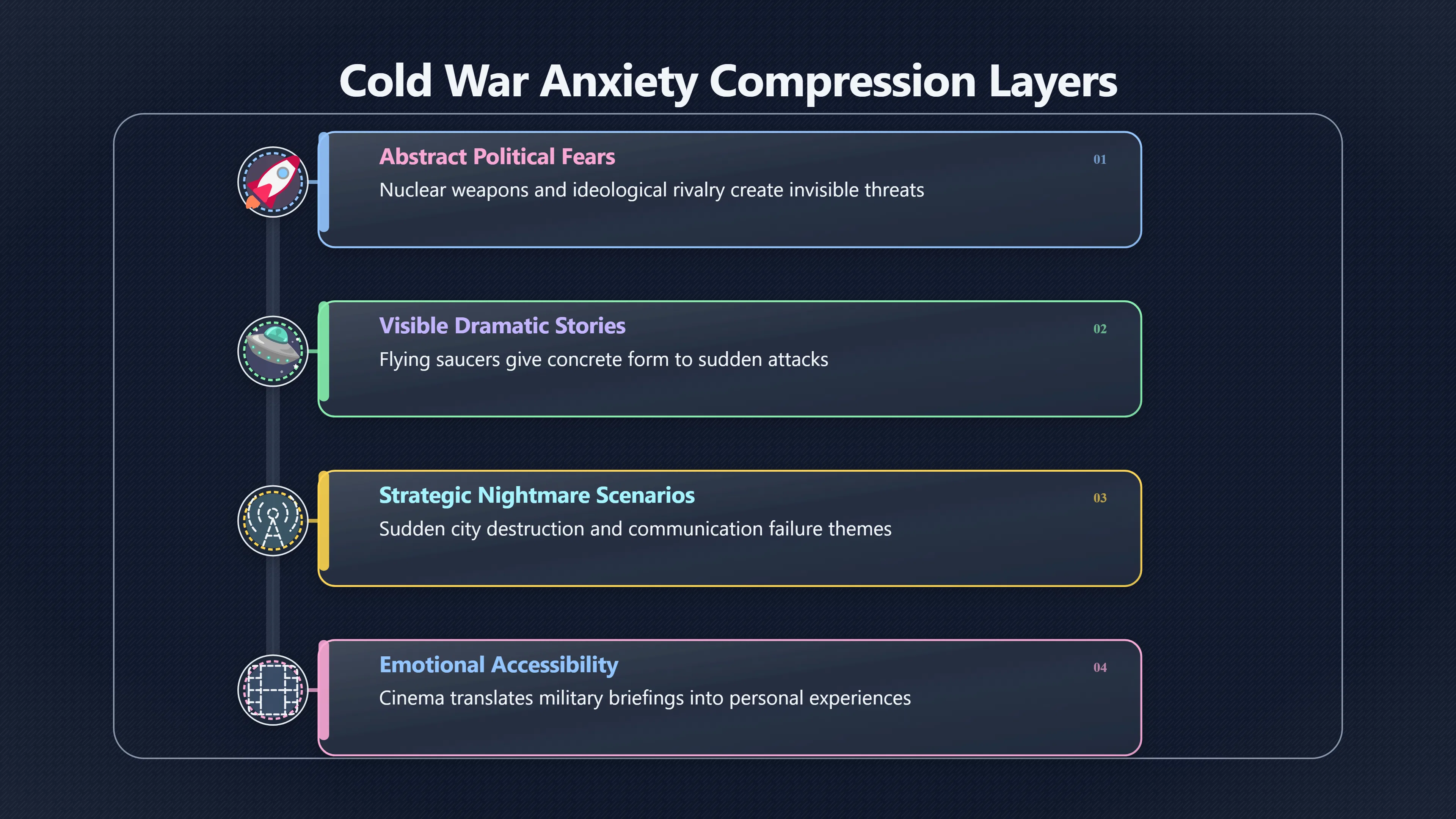
One reason saucer invasion stories felt so modern was that they compressed several different Cold War fears into a single narrative. Audiences lived in a world where military planners worried about long-range bombers, missile attacks and the possibility of little warning before catastrophe. An alien fleet descending from the sky provided a dramatic version of the same concern: a technologically superior enemy could appear suddenly and overwhelm existing defences.
Science-fiction cinema frequently placed ordinary people inside scenarios that resembled strategic nightmares. Cities could be destroyed without warning, communications could fail, and authorities could struggle to understand a new threat. The invasion plot therefore offered an emotionally accessible version of anxieties that otherwise existed in military briefings, newspaper headlines and civil-defence campaigns. Historians of Cold War culture have noted that science-fiction films repeatedly reflected fears about nuclear conflict and the destructive potential unleashed by the atomic age.[Sage Journals]journals.sagepub.comSage Journals Lights, Camera, ArmageddonSage JournalsLights, Camera, Armageddon - Josh Schollmeyer, 2005…
The popularity of flying saucer imagery mattered because it linked these fears to the sky itself. Reports of unidentified aerial objects had already entered public discussion after 1947. Fictional saucers took that uncertainty and pushed it to its most dramatic conclusion: what if the mysterious objects were not merely unexplained aircraft but the advance force of an invasion?
Scientists, generals and warning rooms on screen
Cold War invasion films were also shaped by the institutions that dominated public thinking about security. Scientists, military officers, radar operators and government officials became central characters because they represented the real organisations responsible for detecting and responding to threats.
Films often featured command centres, emergency meetings and attempts to interpret strange signals or sightings. These scenes mirrored the growing importance of air-defence networks and scientific expertise in Cold War society. The tension frequently came not from a battlefield but from uncertainty: authorities had to decide whether an unfamiliar object was harmless, hostile or catastrophic before it was too late.
This pattern is visible in films such as the 1951 version of The Day the Earth Stood Still, where the arrival of an extraterrestrial visitor triggers military mobilisation and political concern. The story is remembered partly because it connected alien contact with contemporary worries about international conflict and nuclear weapons rather than presenting space visitors as purely fantastical beings.[GamesRadar+]gamesradar.comGames Radar+The 10 best alien movies of all timeIt discusses how these films reflect deep themes such as mortality, identity, and humanity’s place in the universe. The list includes tim…
The prominence of laboratories, military headquarters and surveillance systems gave these films a feeling of realism. Audiences recognised the settings from news coverage of defence programmes and atomic research. The fictional invasion therefore seemed connected to the real structures of Cold War power.
Why alien outsiders could stand in for earthly threats
Alien invaders were useful partly because they could represent different fears at the same time. A film did not have to identify a specific nation or ideology as the enemy. The extraterrestrial threat could stand in for whatever audience members found most alarming.
In some interpretations, alien forces resembled fears of communist expansion and foreign infiltration. In others, they reflected anxieties about conformity, political suspicion or mass hysteria. The ambiguity made the stories more powerful because viewers could project contemporary concerns onto the invasion narrative. Scholarly studies of Invasion of the Body Snatchers have long noted that the film supports multiple Cold War readings. The alien takeover can be viewed as a metaphor for communist infiltration, but it can also be interpreted as a critique of McCarthy-era conformity and anti-communist panic.[KCI]kci.go.krKCIThe Cold War in Film:January 1, 2011…
That flexibility helped science fiction avoid becoming simple propaganda. Alien stories could reflect Cold War fears while also questioning them. The outsider from space became a way to discuss political anxieties indirectly, allowing filmmakers to explore tensions that might have been more controversial if presented in a straightforward contemporary setting.
The appeal of invasion without naming the enemy
Another advantage of extraterrestrial villains was that they universalised the threat. A Soviet attack, while frightening, belonged to a specific political moment. An alien invasion could represent any hostile force and therefore felt larger than ordinary geopolitics.
This broader symbolism allowed filmmakers to combine fears of military attack, technological inferiority and cultural vulnerability into a single image. The saucer hovering over a city suggested surveillance, superiority and uncertainty all at once. Audiences did not need detailed knowledge of international strategy to understand the emotional stakes. The visual language of invasion communicated them immediately.
Because UFO reports were already circulating in newspapers and popular culture, flying saucers possessed a special credibility compared with older fantasy creatures. They looked futuristic, technological and potentially real. This gave alien invasion films a distinctive place within the relationship between UFOs and science fiction: they drew power not merely from imagination but from contemporary debates about what might already be appearing in the skies.[The Middle Land]themiddleland.comThe Middle Land UFOs and Aliens Among UsThe Middle LandUFOs and Aliens Among Us - The Middle LandJuly 17, 2023…

Why the theme endured
The enduring influence of these films comes from how effectively they translated Cold War uncertainty into memorable stories. Instead of depicting geopolitical rivalry through treaties, intelligence reports or military budgets, they reduced complex fears to a dramatic question: what happens when an unknown force arrives and nobody knows whether humanity can stop it?
Flying saucer invasion films therefore succeeded because they captured the emotional reality of the Cold War. They transformed invisible threats into visible events, turned strategic anxieties into personal experiences and used alien outsiders to reflect fears that were already present on Earth. In doing so, they helped establish one of the most enduring connections between UFO mythology and science-fiction storytelling.[Sage Journals]journals.sagepub.comSage Journals Lights, Camera, ArmageddonSage JournalsLights, Camera, Armageddon - Josh Schollmeyer, 2005…
Amazon book picks
Further Reading
Books and field guides related to Relationships betwee d7372c cold war saucers 7490a4 saucer invasion film c1609e. Use these as the next step if you want deeper reading beyond the article.
Invasion of the Body Snatchers
A central Cold War-era invasion narrative often interpreted through themes of conformity, infiltration, and ideological fear.
American Science Fiction and the Cold War
Directly examines Cold War themes across science fiction literature and film, including invasion narratives and cultural anxieties.
The War of the Worlds
The foundational alien-invasion story that shaped later flying-saucer and invasion-film traditions.
The Flying Saucers are Real
Captures the flying-saucer fascination that influenced public imagination and 1950s invasion cinema.
eBay marketplace picks
Marketplace Samples
Example marketplace items related to this page. Use the search link to explore similar finds on eBay.




Endnotes
1.
Source: gamesradar.com
Title: [Games]({{ ‘games/’ | relative_url }}) Radar+The 10 best alien movies of all time
Link:https://www.gamesradar.com/entertainment/best-alien-movies/
Source snippet
It discusses how these films reflect deep themes such as mortality, identity, and humanity’s place in the universe. The list includes tim...
2.
Source: kci.go.kr
Title: KCIThe Cold War in Film:
Source snippet
January 1, 2011...
Published: January 1, 2011
3.
Source: themiddleland.com
Title: The Middle Land UFOs and Aliens Among Us
Link:https://themiddleland.com/ufos-and-aliens-among-us/
Source snippet
The Middle LandUFOs and Aliens Among Us - The Middle LandJuly 17, 2023...
Published: July 17, 2023
4.
Source: journals.sagepub.com
Title: Sage Journals Lights, Camera, Armageddon
Link:https://journals.sagepub.com/doi/10.2968/061003012
Source snippet
Sage JournalsLights, Camera, Armageddon - Josh Schollmeyer, 2005...
5.
Source: britannica.com
Title: Invasion of the Body Snatchers film by Kaufman
Link:https://www.britannica.com/topic/Invasion-of-the-Body-Snatchers-film-by-Kaufman
Source snippet
of the Body Snatchers | film by Kaufman [1978] | Britannica...
Additional References
6.
Source: thetimes.co.uk
Link:https://www.thetimes.co.uk/article/were-not-prepared-for-an-apocalypse-now-qprd9gq6x
Source snippet
The piece argues Trump's strategies — such as attacking Iran's nuclear facilities and courting authoritarian figures — could prompt nucle...
7.
Source: tandfonline.com
Link:https://www.tandfonline.com/doi/abs/10.1080/01439685.2015.1134109
Source snippet
lm, Radio and [Television]({{ 'television/' | relative_url }}): Vol 36, No 1February 3, 2016...
Published: February 3, 2016
8.
Source: youtube.com
Link:https://www.youtube.com/watch?v=vrjNUoiBw6s
Source snippet
Cold War. Six American Films, 1950/64. Lecture #4. Invasion of the Body Snatchers (1956)...
9.
Source: youtube.com
Title: Cold War Paranoia in Science Fiction: The 27th Day vs. Red Planet Mars
Link:https://www.youtube.com/watch?v=Q6yKf54gxTg
Source snippet
How This 50s Movie Showed Us the End of the World—And It Wasn't Fiction...
10.
Source: youtube.com
Title: How This 50s Movie Showed Us the End of the World—And It Wasn’t Fiction
Link:https://www.youtube.com/watch?v=UQzaVec6xCk
Source snippet
Why This 1956 Alien Invasion Film Still Terrifies Viewers Today...
11.
Source: britannica.com
Title: Encyclopedia Britannica United States
Link:https://www.britannica.com/place/United-States/The-Red-Scare
Source snippet
Encyclopedia BritannicaUnited States - Red Scare, McCarthyism, Cold War | Britannica...
12.
Source: journals.narfu.ru
Link:https://journals.narfu.ru/index.php/gum/article/view/625
Source snippet
Серия «Гуманитарные и социальные науки»...
13.
Source: youtube.com
Link:https://www.youtube.com/watch?v=jUzzNL6iCUg
Source snippet
Cold War Paranoia in Science Fiction: The 27th Day vs. Red Planet Mars...
14.
Source: youtube.com
Link:https://www.youtube.com/watch?v=J_W_ztVPl2A
15.
Source: britannica.com
Title: www.britannica.com Mc Carthyism Facts | Britannica
Link:https://www.britannica.com/facts/McCarthyism
Source snippet
Facts | BritannicaMarch 1, 2026...
Published: March 1, 2026
Topic Tree