Within Arnold Sighting
How Headlines Made Flying Saucers
The phrase 'flying saucer' shows how a messy witness account became a simple national image almost overnight.
On this page
- From local interview to wire service story
- Why 'saucer' was easier to remember
- The difference between motion words and shape words
Page outline Jump by section
Introduction
The phrase “flying saucer” did not emerge because Kenneth Arnold neatly described a disc-shaped craft. It emerged because newspapers needed a short, memorable label for a complicated aviation story. Within roughly a day of Arnold’s 24 June 1947 sighting near Mount Rainier, reporters, wire services and headline writers compressed a mixture of observations about speed, motion, brightness and shape into two simple words. That compression mattered. It transformed a difficult witness account into a vivid national image and helped establish the visual vocabulary that later linked UFO culture with science-fiction imagery. The mechanism was not merely a reporting error; it was a process of simplification in which the needs of news media favoured a striking image over a nuanced description.[National Air and Space Museum]airandspace.si.edu1947 year flying saucerNational Air and Space Museum1947: Year of the Flying Saucer | National Air and Space MuseumJune 24, 2022…

From Local Interview to Wire-Service Story
Arnold first told his story to reporters from the East Oregonian in Pendleton, Oregon. Early coverage described “saucer-like” objects rather than introducing a fully formed category called “flying saucers”. Yet once the story entered the Associated Press and other wire networks, editors around the country had to summarise it quickly for readers who had never heard of Arnold.[National Air and Space Museum]airandspace.si.edu1947 year flying saucerNational Air and Space Museum1947: Year of the Flying Saucer | National Air and Space MuseumJune 24, 2022…
This was exactly the kind of environment in which a shorthand label could spread rapidly. Newspapers were competing for attention, radio stations were repeating the story, and headline writers needed a phrase that could fit into a few words. According to the National Air and Space Museum, Associated Press coverage described “nine bright saucer-like objects”, and by the following afternoon newspapers were already running references to “flying saucers”. One prominent example was the headline “Supersonic Flying Saucers Sighted by Idaho Pilot.”[National Air and Space Museum]airandspace.si.edu1947 year flying saucerNational Air and Space Museum1947: Year of the Flying Saucer | National Air and Space MuseumJune 24, 2022…
The speed of this transformation is important. The phrase was not the result of decades of cultural development. It became nationally recognisable almost immediately because wire services distributed a standardised version of the story to hundreds of newspapers at once.[National Air and Space Museum]airandspace.si.edu1947 year flying saucerNational Air and Space Museum1947: Year of the Flying Saucer | National Air and Space MuseumJune 24, 2022…
Why “Saucer” Was Easier to Remember
News organisations often reduce complex events to a memorable image. Arnold’s account contained several elements that were difficult to communicate quickly:
- Nine objects moving together.
- Extraordinary estimated speed.
- Unusual flashes of reflected light.
- An irregular, weaving flight pattern.
- Shapes that were not easily described in ordinary language.
A “saucer”, by contrast, was familiar to virtually every reader. It required no technical explanation. Readers could picture it instantly. As the story spread, the simple household object became more useful than Arnold’s more detailed descriptions.[National Air and Space Museum]airandspace.si.edu1947 year flying saucerNational Air and Space Museum1947: Year of the Flying Saucer | National Air and Space MuseumJune 24, 2022…
The phrase also solved a practical problem for headline writers. “Flying saucer” was compact, visual and dramatic. It turned an aviation mystery into an image. Once readers encountered the phrase, they began interpreting later reports through the same mental picture. New sightings were compared to saucers because newspapers had already taught audiences what an unidentified aerial object was supposed to resemble.[National Air and Space Museum]airandspace.si.edu1947 year flying saucerNational Air and Space Museum1947: Year of the Flying Saucer | National Air and Space MuseumJune 24, 2022…
In this sense, the headline did more than report the event. It supplied a visual template.
The Difference Between Motion Words and Shape Words
One reason the “flying saucer” story has endured is that it sits at the boundary between two different kinds of description.
Arnold later argued that he had been describing how the objects moved rather than what they looked like. The famous explanation holds that he compared their motion to a saucer skipping across water, and that journalists converted a movement analogy into a shape description. This interpretation captures part of the story, but the historical record is more complicated.[National Air and Space Museum]airandspace.si.edu1947 year flying saucerNational Air and Space Museum1947: Year of the Flying Saucer | National Air and Space MuseumJune 24, 2022…
Contemporary reports contain references not only to motion but also to saucer-like appearance. The National Air and Space Museum notes that accounts from the period credited Arnold with terms such as “saucer”, “disk” and “pie-pan”. Other early reports likewise referred to shapes resembling household dishes. Meanwhile, descriptions of movement included comparisons to weaving, flipping or darting motions rather than a single skipping-stone analogy. National Air and Space Museum+2The Daily Grail[airandspace.si.edu]airandspace.si.edu1947 year flying saucerNational Air and Space Museum1947: Year of the Flying Saucer | National Air and Space MuseumJune 24, 2022…
What matters for understanding the headline effect is that newspapers tended to privilege shape words over motion words. Motion requires explanation and context. Shape can be communicated instantly. A headline saying that objects moved “like a fish flipping in the sun” or “like the tail of a kite” is difficult to process. A headline saying “flying saucers” creates an immediate image.[The Daily Grail]dailygrail.comOpen source on dailygrail.com.
The result was a shift from describing behaviour to describing appearance.
How a Headline Became a Cultural Image
The media shorthand had consequences far beyond the original sighting. Arnold’s own later sketches did not perfectly match the classic circular flying disc that entered popular culture. Nevertheless, the phrase “flying saucer” encouraged artists, readers and later witnesses to imagine smooth circular craft.[National Air and Space Museum]airandspace.si.edu1947 year flying saucerNational Air and Space Museum1947: Year of the Flying Saucer | National Air and Space MuseumJune 24, 2022…
This is where the story intersects with the broader relationship between UFOs and science fiction. Science-fiction magazines and illustrations already contained unusual aerial vehicles, but the newspaper phrase supplied a standard visual symbol that could move easily between journalism, entertainment and popular belief. Once “flying saucer” became established, fiction writers, comic artists, filmmakers and readers shared a common image.[National Air and Space Museum]airandspace.si.edu1947 year flying saucerNational Air and Space Museum1947: Year of the Flying Saucer | National Air and Space MuseumJune 24, 2022…
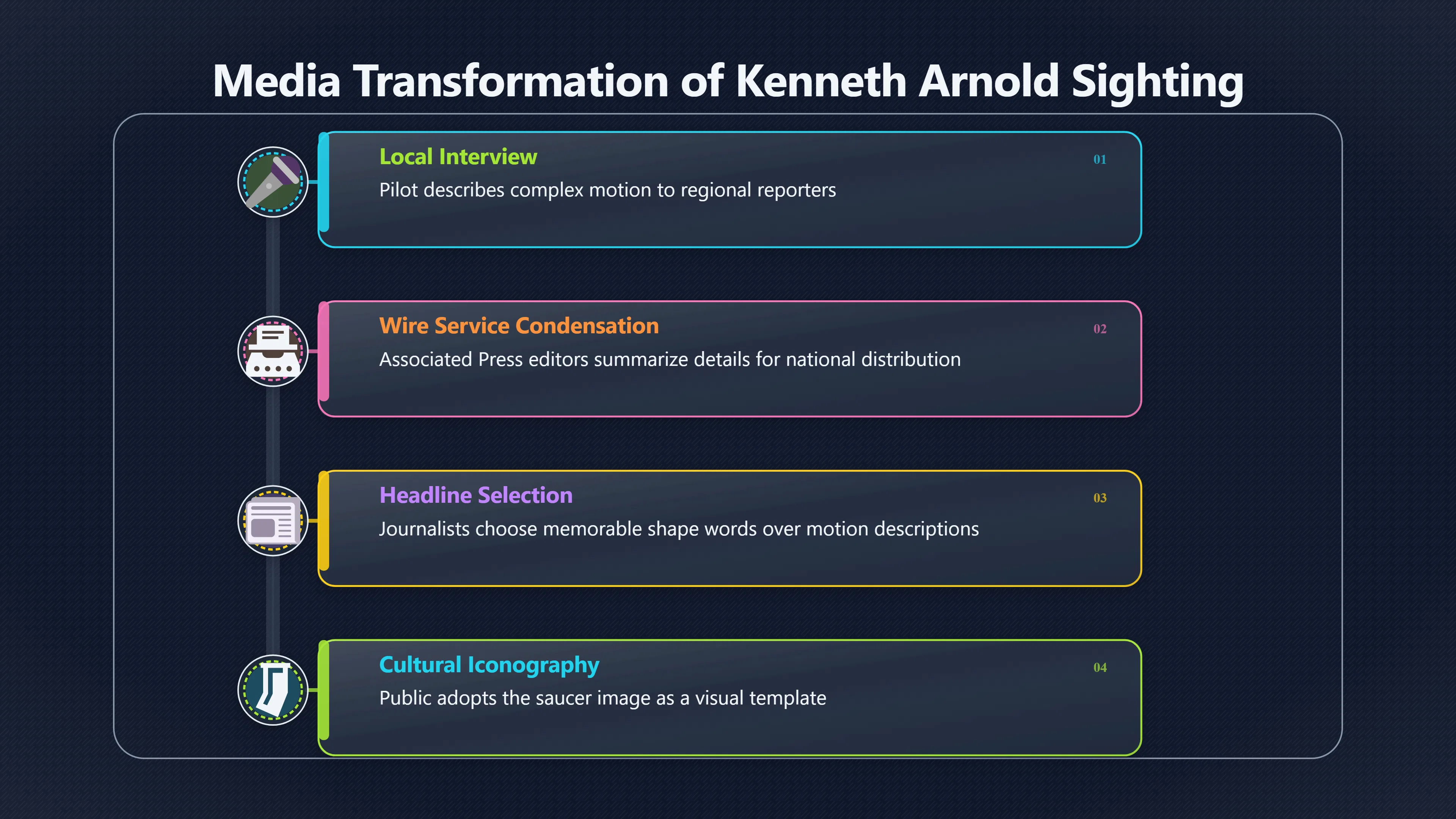
The key mechanism was therefore not a single mistaken quotation. It was the cumulative effect of news production. Local reporting produced a complex account. Wire services condensed it. Headline writers selected the most memorable image. Readers adopted that image. Within days, a witness report had become a cultural icon.
Why the Headline Effect Still Matters
The Arnold case remains one of the clearest examples of how media language can shape public perception. Newspapers did not simply transmit information about an unexplained sighting. They transformed that information into a portable symbol.
The phrase “flying saucer” survived because it was easier to remember than the underlying testimony. In the process, the public image of UFOs became more uniform than the original evidence. That transformation helps explain why the classic UFO of popular culture often resembles a newspaper headline more than Kenneth Arnold’s full description.[National Air and Space Museum]airandspace.si.edu1947 year flying saucerNational Air and Space Museum1947: Year of the Flying Saucer | National Air and Space MuseumJune 24, 2022…
Amazon book picks
Further Reading
Books and field guides related to Relationships betwee d7372c kenneth arnold sauce 924867 newspaper saucer phr c2aef7. Use these as the next step if you want deeper reading beyond the article.

UFOs : Generals, Pilots, and Government Officials Go on the R...
Shows the long legacy of UFO terminology and reporting.
eBay marketplace picks
Marketplace Samples
Example marketplace items related to this page. Use the search link to explore similar finds on eBay.
Endnotes
1.
Source: airandspace.si.edu
Title: 1947 year flying saucer
Link:https://airandspace.si.edu/stories/editorial/1947-year-flying-saucer
Source snippet
National Air and Space Museum1947: Year of the Flying Saucer | National Air and Space MuseumJune 24, 2022...
Published: June 24, 2022
2.
Source: airandspace.si.edu
Title: reports ufos 1947 [roswell]({{ ‘roswell/’ | relative_url }}) incident
Link:https://airandspace.si.edu/stories/editorial/reports-ufos-1947-roswell-incident
Source snippet
National Air and Space MuseumReports of UFOs: 1947 Roswell Incident | National Air and Space Museum...
3.
Source: dailygrail.com
Link:https://www.dailygrail.com/2018/07/return-of-the-flying-saucers-re-evaluating-the-kenneth-arnold-ufo-sighting/
Additional References
4.
Source: youtube.com
Link:https://www.youtube.com/watch?v=bretHCA89bQ
Source snippet
24th June 1947: The first widely-reported UFO sighting was made by private pilot Kenneth Arnold...
Published: June 1947
5.
Source: youtube.com
Title: Kenneth Arnold UFO Sighting The First UFOs
Link:https://www.youtube.com/watch?v=xLuHgsXGpqc
Source snippet
BW - EP129—001: Radio, Roswell And The Flying Saucer Craze—Kenneth Arnold And The Roswell Crash...
6.
Source: arxiv.org
Link:https://arxiv.org/abs/1706.02608
Source snippet
June 8, 2017...
Published: June 8, 2017
7.
Source: youtube.com
Title: Where Did The Term ‘Flying Saucer’ Come From? | Mossback’s Northwest
Link:https://www.youtube.com/watch?v=ap0whDDDU1Y
Source snippet
Kenneth Arnold UFO Sighting The First UFOs - Jimmy Akin's Mysterious World...
8.
Source: youtube.com
Link:https://www.youtube.com/watch?v=01sVLTO8xmo
Source snippet
Guinness World Records...
Published: June 1947
9.
Source: youtube.com
Link:https://www.youtube.com/watch?v=oL3hwFyXm20
10.
Source: occult-world.com
Title: Occult World Flying Saucer – Occult World
Link:https://occult-world.com/?p=109925
Topic Tree