Within Headlines
Why UFO Stories Need Simple Shapes
Saucer, orb, triangle and tic-tac labels survive because they turn messy witness reports into repeatable images.
On this page
- Why sighting details are hard to preserve
- How headlines compress uncertainty into icons
- Why standard shapes feed fiction and memory
Page outline Jump by section
Introduction
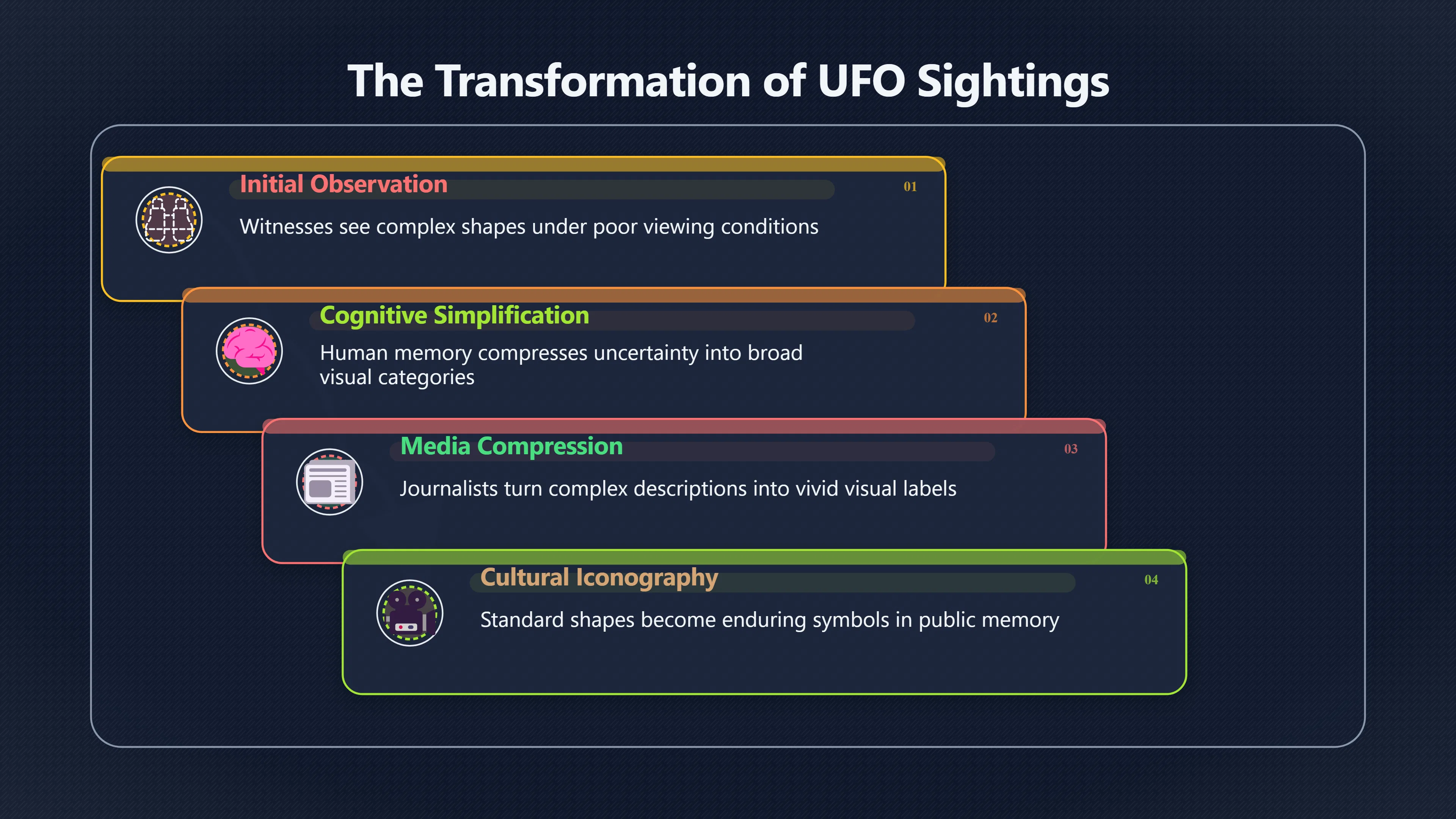
UFO reports usually begin with uncertainty. Witnesses struggle to judge distance, size, speed or even the outline of what they saw. Yet public memory rarely preserves that uncertainty. Instead, it remembers a handful of simple shapes: the flying saucer, the glowing orb, the black triangle and, more recently, the tic-tac. These visual labels survive because they perform a powerful cultural function. They turn complicated observations into easy mental pictures that can fit into a headline, a conversation or a film poster. Once a report is reduced to a recognisable shape, it becomes easier to remember, repeat and connect to existing science-fiction imagery. The result is that a small set of geometric forms comes to represent a much larger and messier body of UFO reports.[Time]time.comThis Is Why People Think UFOs Look Like 'Flying SaucersThe fascination grew to include an incident on July 7, when a New Mexico rancher found what was initially thought to be a crashed flying…
Why Sighting Details Are Hard to Preserve
Most eyewitness reports contain far more uncertainty than later retellings suggest. Observers often see objects under poor viewing conditions, at unknown distances, against bright skies, clouds or darkness. They may remember movement, brightness or direction more clearly than precise shape.
Because detailed descriptions are difficult to communicate, people naturally simplify. Instead of recalling every uncertainty, they retain a broad visual category: round, triangular, cylindrical or oval. Researchers in visual cognition have long found that simplified symbolic forms are easier to recognise and recall than complex visual information. Simple shapes function as mental shortcuts that reduce cognitive effort and improve memorability.[PubMed]pubmed.ncbi.nlm.nih.govPub Med Symbolic forms can be mnemonics for recallSymbolic forms can be mnemonics for recall - PubMed…
This simplification is especially important for UFO stories because the original observation is often fleeting. By the time a witness speaks to journalists, friends or investigators, the memory has already been compressed into a more manageable image. Shape becomes the surviving feature because it is easier to describe than uncertainty.
How Headlines Compress Uncertainty Into Icons
The classic example is the “flying saucer”. Kenneth Arnold’s 1947 sighting became famous not because the public studied his full description, but because newspapers condensed it into a vivid visual label. Arnold compared the motion of the objects to a saucer skipping across water, yet reporting quickly transformed that comparison into the idea of saucer-shaped craft. The phrase spread nationally because it gave readers an instant picture.[time.com]time.comThis Is Why People Think UFOs Look Like 'Flying SaucersThe fascination grew to include an incident on July 7, when a New Mexico rancher found what was initially thought to be a crashed flying…
This process reveals an important media mechanism. Headlines are designed for speed and recognition. A phrase such as “unidentified aerial object displaying unusual movement” is accurate but difficult to visualise. A “flying saucer” is immediately understandable.
Over time, the label becomes more memorable than the original report. Readers may forget where, when or under what conditions a sighting occurred, but they remember the image. The headline effectively creates an icon. Once established, that icon becomes available for future stories, allowing later sightings to be compared to a familiar category rather than described from scratch.[Time]time.comThis Is Why People Think UFOs Look Like 'Flying SaucersThe fascination grew to include an incident on July 7, when a New Mexico rancher found what was initially thought to be a crashed flying…
The same process can be seen in later UFO vocabulary. Terms such as “orb”, “triangle” and “tic-tac” are successful partly because they communicate a shape in a single word. They compress uncertainty into something that can be visualised immediately.

Why Only a Few Shapes Become Cultural Standards
Thousands of UFO reports contain unusual or highly specific descriptions. Some accounts mention irregular forms, changing outlines or shapes that resist easy classification. Yet these rarely dominate public memory.
The reason is that standard shapes are easier to categorise. A circle, triangle or capsule can be recognised instantly and reproduced endlessly. They can be drawn by a newspaper illustrator, rendered in a film, turned into a logo or recalled years later without much loss of detail.
Recent discussions of reported UAP (Unidentified Anomalous Phenomena) still show this tendency. Even when witnesses describe a wide variety of forms, reports are commonly grouped into recurring categories such as spheres, discs, triangles and elongated objects. More unusual descriptions exist but attract less lasting recognition because they lack a stable visual shorthand.[nypost.com]nypost.comTestimonies revisited past claims with little new evidence. Key figures like Dr. Tim Gallaudet and Luis Elizondo described government sec…
This is not unique to UFO culture. Human memory generally favours distinctive symbolic patterns. Simple forms become categories, and categories become stories. Once a shape has become culturally familiar, new reports are more likely to be described in terms that fit it.
Why Standard Shapes Feed Science Fiction And Memory
The relationship between UFOs and science fiction becomes strongest at this stage. A simple shape can move easily between news reporting and fiction.
A saucer can become a spacecraft. A triangle can become an advanced military vehicle or alien scout. A glowing orb can become a mysterious intelligence. Because the shapes are visually simple, writers, artists and filmmakers can adapt them repeatedly without losing recognisability.
The flying saucer demonstrates this process most clearly. What began as a media-friendly label evolved into one of the most enduring symbols in science fiction. By the 1950s it was appearing in films, comics, magazine covers and advertising. Eventually the saucer became so familiar that many people associated UFOs with the image even when reports described something entirely different.[HandWiki]handwiki.orgHand Wiki Engineering:Flying saucerEngineering:Flying saucer - HandWiki…
The same pattern appears in modern UAP discussions. The “tic-tac” label gained traction because it provides an equally simple visual reference. An elongated white capsule is easy to picture, easy to discuss and easy to reproduce in media coverage. Once established, the image becomes part of the cultural vocabulary available to both journalists and storytellers.[New York Post]nypost.comTestimonies revisited past claims with little new evidence. Key figures like Dr. Tim Gallaudet and Luis Elizondo described government sec…
The Feedback Loop Between Shape And Story
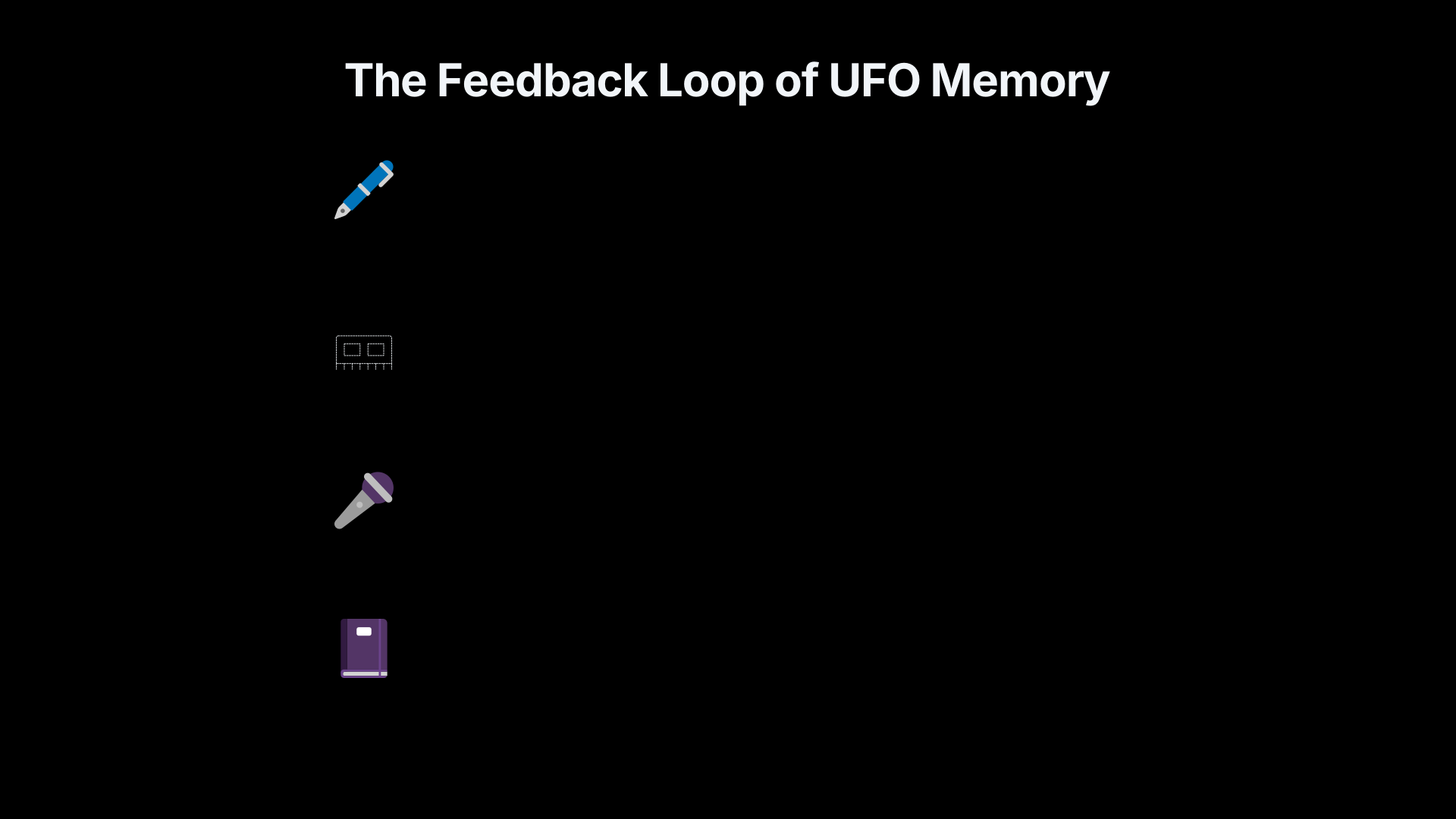
Simple UFO shapes dominate public memory because they sit at the intersection of perception, journalism and imagination. Witnesses simplify uncertain observations into broad visual categories. Headlines turn those categories into memorable labels. Popular culture then repeats the labels until they become familiar symbols.
As the symbols spread, they influence how future reports are discussed and remembered. The public rarely retains the full complexity of a sighting, but it remembers the shape attached to it. In that sense, saucers, orbs, triangles and tic-tacs are not merely descriptions. They are cultural containers that allow UFO stories to survive, circulate and merge with the visual language of science fiction.[time.com]time.comThis Is Why People Think UFOs Look Like 'Flying SaucersThe fascination grew to include an incident on July 7, when a New Mexico rancher found what was initially thought to be a crashed flying…
eBay marketplace picks
Marketplace Samples
Live-tested eBay searches with available results related to this page.




Endnotes
1.
Source: time.com
Title: This Is Why People Think UFOs Look Like ‘Flying Saucers’
Link:https://time.com/3930602/first-reported-ufo/
Source snippet
The fascination grew to include an incident on July 7, when a New Mexico rancher found what was initially thought to be a crashed flying...
2.
Source: handwiki.org
Title: Hand Wiki Engineering:Flying saucer
Link:https://www.handwiki.org/wiki/Engineering%3AFlying_saucer
Source snippet
Engineering:Flying saucer - HandWiki...
3.
Source: clickondetroit.com
Link:https://www.clickondetroit.com/news/politics/2026/06/12/new-ufo-files-describe-spinning-discs-glowing-orbs-and-one-object-shaped-like-a-potato/
4.
Source: pubmed.ncbi.nlm.nih.gov
Title: Pub Med Symbolic forms can be mnemonics for recall
Link:https://pubmed.ncbi.nlm.nih.gov/24203557/
Source snippet
Symbolic forms can be mnemonics for recall - PubMed...
5.
Source: nypost.com
Link:https://nypost.com/2024/11/14/us-news/congressional-ufo-hearing-details-alleged-secret-government-programs-descriptions-of-alien-craft/
Source snippet
Testimonies revisited past claims with little new evidence. Key figures like Dr. Tim Gallaudet and Luis Elizondo described government sec...
Additional References
6.
Source: psychology.uchicago.edu
Link:https://psychology.uchicago.edu/news/certain-visual-qualities-make-symbols-more-memorable-or-forgettable-suggesting-we-can
Source snippet
Department of PsychologyCertain visual qualities make symbols more memorable or forgettable, suggesting we can strengthen these simple co...
7.
Source: nature.com
Link:https://www.nature.com/articles/nrn2154
Source snippet
memory and the medial temporal lobe: a new perspective | Nature Reviews Neuroscience...
8.
Source: youtube.com
Title: What We Know About UFOs (It’s Stranger Than You Think) | Jesse Michels
Link:https://www.youtube.com/watch?v=7IIVtHgJVqU
Source snippet
This video on Where Did The Term 'Flying Saucer' Come From? details how Kenneth Arnold's description of objects skipping like saucers acr...
9.
Source: journals.sagepub.com
Link:https://journals.sagepub.com/doi/abs/10.1177/0963721417700504
Source snippet
Jill Talley Shelton, Michael K. Scullin, 2017August 9, 2017...
Published: August 9, 2017
10.
Source: aliencatalog.com
Link:https://www.aliencatalog.com/
Source snippet
Catalog | AlienCatalog.com Official UFO and UAP Records...
11.
Source: youtube.com
Link:https://www.youtube.com/watch?v=z25NfZ0Ea9c
Source snippet
The UFO Deluge of July 4th, 1947 | Part 1: Omens (Before the Storm)...
12.
Source: youtube.com
Title: HISTORY of UFOs and ALIENS
Link:https://www.youtube.com/watch?v=dnNJMAHprys
Source snippet
History of UFO and alien encounters | Prof. Greg Eghigian...
13.
Source: youtube.com
Title: The History and Evolution of UFOs and UAPs
Link:https://www.youtube.com/watch?v=JpIxnVWkeh4
Source snippet
What Would Real Aliens Actually Look Like?...
14.
Source: youtube.com
Title: Kenneth Arnold UFO Sighting The First UFOs
Link:https://www.youtube.com/watch?v=xLuHgsXGpqc
Source snippet
Kenneth Arnold and the First UFOs - Jimmy Akin's Mysterious World...
15.
Source: youtube.com
Title: Where Did The Term ‘Flying Saucer’ Come From? | Mossback’s Northwest
Link:https://www.youtube.com/watch?v=ap0whDDDU1Y
Source snippet
Kenneth Arnold UFO Sighting The First UFOs - Jimmy Akin's Mysterious World...
Topic Tree