Within Pulp Roots
Why strange shapes could still look like craft
Early pulp spacecraft appeared as rockets, cylinders, liners and hybrids, making unfamiliar aerial shapes easier to read as vehicles.
On this page
- Rockets, cylinders, liners and hybrid machines
- Why saucers were not the only imagined shape
- How visual variety prepared UFO interpretation
Page outline Jump by section
Introduction
Before the flying saucer became the dominant image of UFO culture, pulp science-fiction magazines had already taught readers to recognise many different kinds of flying machines. From the 1920s through the early 1940s, magazine covers and stories presented spacecraft as rockets, cylinders, spheres, streamlined liners, flying submarines and elaborate hybrid vehicles. The result was a subtle but important shift in expectations: a technological craft did not have to resemble a conventional aeroplane to be interpreted as a machine. When later witnesses reported unusual aerial objects, they were describing them within a culture already familiar with the idea that advanced vehicles might take unfamiliar forms. This did not create UFO reports, but it broadened the range of shapes that could plausibly be read as engineered craft rather than natural phenomena.[SF Encyclopedia]sf-encyclopedia.comSF Encyclopedia SFE: SpaceshipsSF EncyclopediaSFE: SpaceshipsFebruary 17, 2025
Rockets, cylinders, liners and hybrid machines
Early science fiction inherited a wide assortment of spacecraft concepts rather than a single visual template. Nineteenth- and early twentieth-century stories imagined space travel in projectiles fired from giant guns, spherical vessels, bullet-shaped craft and even machines resembling submarines. Because propulsion methods were often fictional or unexplained, designers were not constrained by the aerodynamic requirements that shaped real aircraft.[SF Encyclopedia]sf-encyclopedia.comSF Encyclopedia SFE: SpaceshipsSF EncyclopediaSFE: SpaceshipsFebruary 17, 2025
When specialised science-fiction magazines emerged in the pulp era, this diversity became even more visible. According to The Encyclopedia of Science Fiction, illustrators such as Frank R. Paul frequently depicted spacecraft as enormous bloated aeroplanes, rounded ocean liners with rows of portholes, or fantastical vehicles combining features from ships, cars and aircraft. Many covers showed machines whose purpose was immediately recognisable as transportation, yet whose shape differed dramatically from any aircraft then flying in the real world.[SF Encyclopedia]sf-encyclopedia.comSF Encyclopedia SFE: SpaceshipsSF EncyclopediaSFE: SpaceshipsFebruary 17, 2025
Several recurring forms appeared across pulp illustrations:
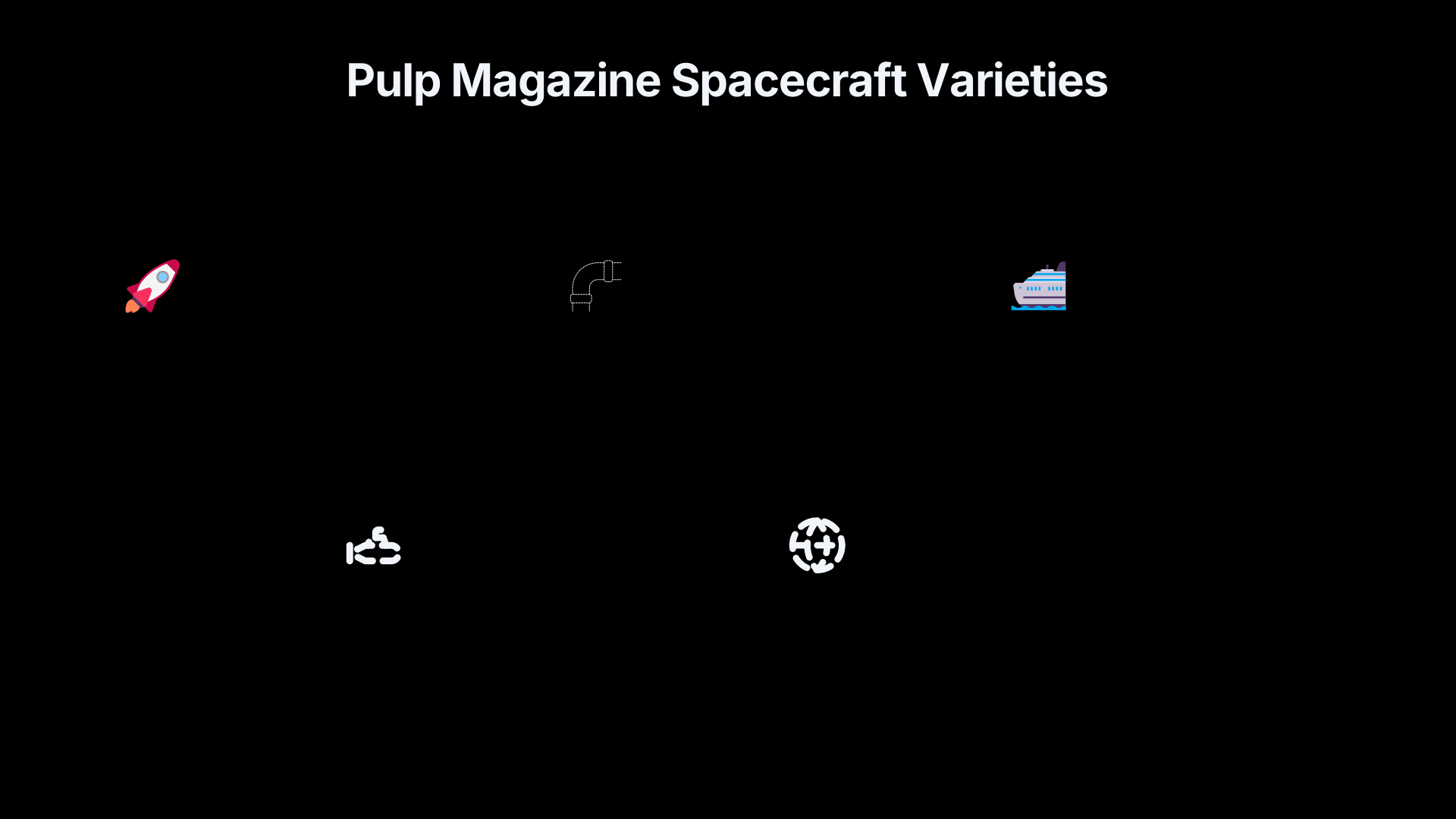
- Rocketships with fins, flames and pointed noses.
- Cylindrical vessels resembling giant shells, tubes or projectiles.
- Space liners inspired by ocean-going passenger ships, complete with windows and decks.
- Flying-submarine hybrids, borrowing imagery from underwater exploration.
- Spherical and bulbous craft, often justified by fictional propulsion systems.[SF Encyclopedia]sf-encyclopedia.comSF Encyclopedia SFE: SpaceshipsSF EncyclopediaSFE: SpaceshipsFebruary 17, 2025
The important cultural effect was that readers learned to identify a vehicle through context and function rather than through a fixed shape. A machine could be round, elongated or completely unconventional and still be understood as a craft.
Why saucers were not the only imagined shape
Modern discussions sometimes assume that science fiction primed the public specifically for saucer-shaped UFOs. The historical record is more complicated. Pulp magazines displayed an extraordinary range of spacecraft designs, and saucers were only one possibility among many.
Frank R. Paul, arguably the most influential artist of early American science fiction, became famous for illustrating giant machines of every conceivable form. Commentators on his work have noted that he even depicted saucer-like spacecraft before the term “flying saucer” entered popular culture, but those images existed alongside rockets, globes, towers, cylinders and elaborate mechanical structures. The defining feature was not the saucer shape itself but the assumption that advanced technology might look radically different from contemporary engineering.[Amazing Stories]amazingstories.comAmazing Stories I Dreamed I Saw the Silver SpaceshipsAmazing StoriesI Dreamed I Saw the Silver Spaceships - Amazing StoriesJanuary 4, 2013…
This distinction matters. If pulp readers had been exposed only to aircraft-like spacecraft, then later reports of discs, cylinders or unconventional objects might have seemed less technological. Instead, decades of illustration had already normalised the idea that future vehicles could abandon familiar aviation forms. The visual culture of the pulps expanded the category of what counted as a machine.

How visual variety prepared UFO interpretation
The mechanism linking pulp magazines to later UFO interpretation was not prediction but expectation management. Real aeroplanes trained observers to associate technology with wings, propellers and recognisable aerodynamic structures. Pulp science fiction weakened that expectation by repeatedly presenting vehicles that achieved flight or space travel through entirely different principles.[SF Encyclopedia]sf-encyclopedia.comSF Encyclopedia SFE: SpaceshipsSF EncyclopediaSFE: SpaceshipsFebruary 17, 2025
Readers therefore encountered three related ideas:
- Advanced technology might not resemble current technology.
- A vehicle could be engineered even if its purpose or propulsion was unknown.
- Unusual shapes could signal greater sophistication rather than impossibility. SF Encyclopedia
This mental framework became especially important in a period when aviation itself was changing rapidly. Between the First World War and the dawn of the jet age, aircraft design evolved dramatically. Against that backdrop, pulp illustrations encouraged readers to think that future machines might depart even further from present-day norms. A strange object in the sky could therefore be interpreted not merely as an anomaly but as a vehicle operating according to principles beyond contemporary engineering. Encyclopedia Britannica
The effect was cultural rather than evidential. Pulp magazines did not tell readers what UFOs were. They helped create a visual vocabulary in which a technological craft no longer needed to look like an aeroplane.
The lasting shift in technological imagination
By the time the UFO era emerged after 1947, popular culture had already spent two decades absorbing images of spacecraft in wildly different forms. Adventure magazines such as Amazing Stories, Wonder Stories and Astounding circulated covers filled with machines that ignored ordinary aviation conventions while remaining clearly artificial and purposeful. Encyclopedia Britannica+2SF Encyclopedia
That legacy helps explain why reports of discs, cylinders, cigar-shaped objects and other unconventional aerial forms could be interpreted as craft rather than immediately dismissed as impossible. The pulps had already loosened the connection between “machine” and “aeroplane”. In the imagination shaped by early science fiction, technology occupied a much broader visual territory. A flying object could be strange, unfamiliar and unlike any aircraft on Earth, yet still look as though it belonged to a civilisation capable of building vehicles. SF Encyclopedia
Amazon book picks
Further Reading
Books and field guides related to Relationships betwee d7372c pulp scifi ufo roots 18b6cc pulp spaceship shape 342f79. Use these as the next step if you want deeper reading beyond the article.
Frank R. Paul Father of Science Fiction Art
Showcases the artist behind many influential spacecraft depictions.
The Art of Chesley Bonestell
Demonstrates how visual representations of space technology evolved.
Project Mars
Illustrates the transition from imaginative spacecraft to more technical visions.
eBay marketplace picks
Marketplace Samples
Example marketplace items related to this page. Use the search link to explore similar finds on eBay.



Endnotes
2.
Source: britannica.com
Title: Encyclopedia Britannica Science fiction
Link:https://www.britannica.com/art/science-fiction/Mass-markets-and-juvenile-science-fiction
Source snippet
Encyclopedia BritannicaScience fiction - Futuristic, Imagination, Technology | Britannica...
3.
Source: sf-encyclopedia.com
Title: SF Encyclopedia SFE: Wonder Stories
Link:https://sf-encyclopedia.com/entry/wonder_stories
4.
Source: sf-encyclopedia.com
Title: SF Encyclopedia SFE: Astounding Science-Fiction
Link:https://sf-encyclopedia.com/entry/asf
5.
Source: sf-encyclopedia.com
Title: SF E: Pulp
Link:https://sf-encyclopedia.com/entry/pulp
Source snippet
SFE: PulpFebruary 20, 2023...
Published: February 20, 2023
6.
Source: amazingstories.com
Title: Amazing Stories I Dreamed I Saw the Silver Spaceships
Link:https://amazingstories.com/2013/01/i-dreamed-i-saw-the-silver-spaceships%E2%80%A8/
Source snippet
Amazing StoriesI Dreamed I Saw the Silver Spaceships - Amazing StoriesJanuary 4, 2013...
Published: January 4, 2013
Additional References
7.
Source: scifi.stackexchange.com
Link:https://scifi.stackexchange.com/questions/93537/what-was-the-first-sci-fi-work-to-feature-a-spaceship
Source snippet
What was the first Sci-Fi work to feature a spaceship? - Science Fiction & Fantasy Stack Exchange...
8.
Source: reddit.com
Title: original and final cover artwork by artist frank
Link:https://www.reddit.com/r/RetroFuturism/comments/1pt40qe/original_and_final_cover_artwork_by_artist_frank/
Source snippet
and final cover artwork by artist Frank R. Paul for Wonder Stories Quarterly, 1931December 22, 2025...
Published: December 22, 2025
9.
Source: sm-201.org
Title: www.sm-201.org Uncanny Tales (Canadian pulp magazine)
Link:https://www.sm-201.org/a/Uncanny_Tales_%28Canadian_pulp_magazine%29
Source snippet
Tales (Canadian pulp magazine) - Robin's SM-201 Website...
10.
Source: pulpworld.com
Link:https://www.pulpworld.com/biography/frank_paul.htm
11.
Source: youtube.com
Link:https://www.youtube.com/watch?v=P_vvFOf4U80
Source snippet
Pulp Science: A Brief History of Science Fiction Magazines...
12.
Source: youtube.com
Title: Pulp Science: A Brief History of Science Fiction Magazines
Link:https://www.youtube.com/watch?v=pWxXCPe0oEM
Source snippet
2 Mysterious Ships in Science Fiction...
13.
Source: reddit.com
Title: www.reddit.comuntitled illustration by Frank R. Paul
Link:https://www.reddit.com/r/ImaginaryStarships/comments/x7b6lj
Source snippet
September 6, 2022...
Published: September 6, 2022
14.
Source: fancyclopedia.org
Title: Thrilling Wonder Stories
Link:https://fancyclopedia.org/wiki/Science_Wonder_Stories
15.
Source: tropedia.fandom.com
Title: Retro Rocket | Tropedia | Fandom
Link:https://tropedia.fandom.com/wiki/Retro_Rocket
16.
Source: pulpmags.org
Title: www.pulpmags.org Wonder Stories
Link:https://www.pulpmags.org/content/info/wonder-stories.html
Topic Tree