Within Arnold Sighting
What Did Arnold Actually See?
Kenneth Arnold's drawings and descriptions were stranger than the neat disc image that later dominated UFO culture.
On this page
- Arnold's reported forms and motion
- Why later retellings simplified the shapes
- How the stereotype changed the evidence story
Page outline Jump by section
Introduction
The most famous image in UFO culture is the classic flying saucer: a neat, circular disc, often shown with a domed top and metallic finish. Yet that image does not closely match the shapes Kenneth Arnold described and later drew after his 24 June 1947 sighting near Mount Rainier. The historical record shows a more complicated picture. Arnold’s objects were reported as unusual, asymmetrical forms whose motion and outline were difficult to classify, and his own sketch for the U.S. Air Force looked more like a crescent or the heel of a shoe than a perfect disc. The gap between what Arnold described and what the public remembered became one of the most important transformations in UFO history, helping create a visual stereotype that would later merge easily with science-fiction imagery.[National Air and Space Museum]airandspace.si.edu1947 year flying saucerNational Air and Space Museum1947: Year of the Flying Saucer | National Air and Space MuseumJune 24, 2022…
What Did Arnold Actually See?
Arnold’s reported forms and motion
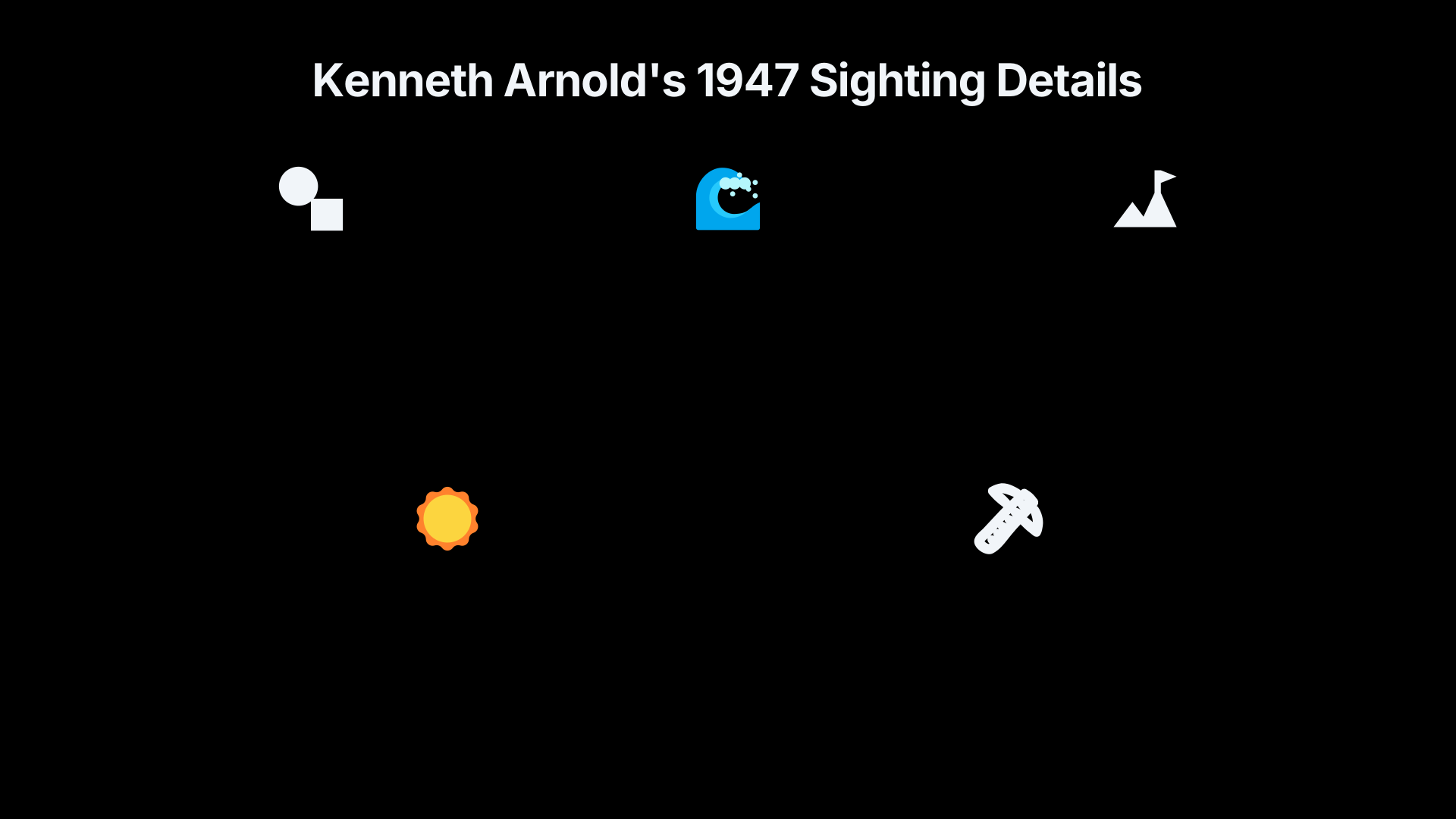
A common misconception is that Arnold reported seeing nine identical saucers. Contemporary accounts are less straightforward. Early newspaper coverage described the objects as unusual and, in one report, “somewhat bat-shaped”. Arnold also used comparisons such as “saucer-like”, but these descriptions appeared alongside references to unconventional outlines rather than perfect circular discs.[nicap.org]nicap.orgFrom Airships to Flying Saucers: Oregon's Place in the Evolution of UFO LoreFrom Airships to Flying Saucers: Oregon's Place in the Evolution of UFO Lore
The strongest evidence comes from Arnold’s own later documentation. In a report sent to the U.S. Air Force in July 1947, he drew a shape with a rounded front edge and a tapered rear section. The Smithsonian’s National Air and Space Museum notes that the drawing resembled the heel of a shoe rather than a classic saucer. The form was broad and curved but not symmetrical, lacking the familiar domed-disc appearance that later became standard in UFO art.[National Air and Space Museum]airandspace.si.edu1947 year flying saucerNational Air and Space Museum1947: Year of the Flying Saucer | National Air and Space MuseumJune 24, 2022…
Just as important as shape was movement. Arnold repeatedly emphasised the way the objects travelled. He compared their motion to a saucer skipping across water, describing a weaving, flipping progression through the air. The objects appeared to bank and oscillate as they crossed the mountain range, producing flashes of reflected sunlight. In many retellings, the comparison to a skipping saucer became detached from the discussion of movement and was reinterpreted as a statement about shape.[si.edu]airandspace.si.edu1947 year flying saucerNational Air and Space Museum1947: Year of the Flying Saucer | National Air and Space MuseumJune 24, 2022…
This distinction matters because Arnold’s account combined two different observations:
- The outline of the objects, which he later sketched as an unusual crescent or shoe-heel form.
- The motion of the objects, which he compared to a saucer skipping over water.
Once those two ideas became fused in popular reporting, the flying-saucer stereotype emerged.[National Air and Space Museum]airandspace.si.edu1947 year flying saucerNational Air and Space Museum1947: Year of the Flying Saucer | National Air and Space MuseumJune 24, 2022…
Why Later Retellings Simplified the Shapes
The original descriptions posed a practical problem for journalists and readers. A shoe-heel-shaped flying object is difficult to picture instantly. A saucer is not. Newspapers needed a concise image that could be communicated in a headline, a sketch or a radio broadcast. The circular saucer provided that simplicity.[National Air and Space Museum]airandspace.si.edu1947 year flying saucerNational Air and Space Museum1947: Year of the Flying Saucer | National Air and Space MuseumJune 24, 2022…
The process began almost immediately. Reports circulated nationally through wire services, and the phrase “flying saucer” spread far more rapidly than any detailed discussion of Arnold’s sketch. Within days, Americans were reporting their own sightings using the new vocabulary. The public increasingly described objects as discs, pie plates, hubcaps and other circular forms. The label itself encouraged witnesses to interpret ambiguous sights through a saucer-shaped framework.[National Air and Space Museum]airandspace.si.edu1947 year flying saucerNational Air and Space Museum1947: Year of the Flying Saucer | National Air and Space MuseumJune 24, 2022…
There is also evidence that Arnold’s own descriptions were not entirely consistent over time. Some accounts recorded him using terms such as “saucer”, “disk” or “pie-pan” when discussing the objects. This has led historians to caution against the oversimplified claim that a single reporter’s mistake created the entire flying-saucer phenomenon. Nevertheless, the visual stereotype that dominated later culture was far cleaner and more symmetrical than the shapes preserved in Arnold’s Air Force drawing.[National Air and Space Museum]airandspace.si.edu1947 year flying saucerNational Air and Space Museum1947: Year of the Flying Saucer | National Air and Space MuseumJune 24, 2022…
The result was a classic case of cultural compression. A complicated eyewitness description became a memorable icon.
How the Stereotype Changed the Evidence Story
The transformation from Arnold’s sketch to the flying-saucer stereotype did more than alter a picture. It changed how later generations interpreted the evidence.
Once the public imagination settled on the image of a circular disc, Arnold’s original shape became increasingly invisible. Illustrations in magazines, films and television programmes often depicted perfect metallic saucers, even when discussing the Mount Rainier sighting itself. Readers encountering the story decades later could easily assume that Arnold had reported exactly the sort of craft seen in later UFO artwork.[National Air and Space Museum]airandspace.si.edu1947 year flying saucerNational Air and Space Museum1947: Year of the Flying Saucer | National Air and Space MuseumJune 24, 2022…
This shift had consequences for the relationship between UFO reports and science fiction. Science-fiction artists and filmmakers found the saucer visually striking, easy to recognise and simple to reproduce. As flying discs became a standard feature of popular culture, those fictional images fed back into public expectations of what UFOs should look like. The original ambiguity of Arnold’s report gradually gave way to a standardised visual language.[National Air and Space Museum]airandspace.si.edu1947 year flying saucerNational Air and Space Museum1947: Year of the Flying Saucer | National Air and Space MuseumJune 24, 2022…
The evidence therefore tells two different stories:
Arnold’s original recordLater saucer stereotypeIrregular, hard-to-classify outlinesClean circular discsMotion emphasised as much as shapeShape became the defining featureCrescent or shoe-heel style sketchesSymmetrical metallic saucersAmbiguous aviation mysteryRecognisable UFO icon
The distinction is important because it reveals how UFO imagery evolved. Arnold’s sighting did not merely launch reports of strange aerial objects. It also demonstrates how media simplification, public memory and science-fiction aesthetics can reshape an event until the remembered image differs significantly from the original description.[si.edu]airandspace.si.edu1947 year flying saucerNational Air and Space Museum1947: Year of the Flying Saucer | National Air and Space MuseumJune 24, 2022…
The Lasting Lesson of Arnold’s Sketch
When historians revisit the Mount Rainier case, one of the most striking discoveries is how unfamiliar Arnold’s own drawing looks compared with the standard flying saucer. The sketch reminds readers that the iconic UFO disc was not simply observed and recorded; it was constructed through a chain of interpretation, retelling and visual simplification.[National Air and Space Museum]airandspace.si.edu1947 year flying saucerNational Air and Space Museum1947: Year of the Flying Saucer | National Air and Space MuseumJune 24, 2022…
In that sense, Arnold’s original shapes occupy a pivotal place in the relationship between UFOs and science fiction. The evidence began as an account of strange, difficult-to-describe aerial forms. Popular culture transformed those forms into the elegant saucer that would dominate UFO fiction, artwork and public imagination for decades.[si.edu]airandspace.si.edu1947 year flying saucerNational Air and Space Museum1947: Year of the Flying Saucer | National Air and Space MuseumJune 24, 2022…

eBay marketplace picks
Marketplace Samples
Example marketplace items related to this page. Use the search link to explore similar finds on eBay.
Endnotes
1.
Source: nicap.org
Title: From Airships to Flying Saucers: Oregon’s Place in the Evolution of UFO Lore
Link:https://www.nicap.org/articles/prior_47/Bartholomew_R._From_Airships_to_Flying_Saucers_Oregon%27s_Place_in_the_Evolution_of_UFO_Lore.pdf
2.
Source: time.com
Title: This Is Why People Think UFOs Look Like ‘Flying Saucers’On
Link:https://time.com/3930602/first-reported-ufo/
Source snippet
The fascination grew to include an incident on July 7, when a New Mexico rancher found what was initially thought to be a crashed flying...
3.
Source: airandspace.si.edu
Title: 1947 year flying saucer
Link:https://airandspace.si.edu/stories/editorial/1947-year-flying-saucer
Source snippet
National Air and Space Museum1947: Year of the Flying Saucer | National Air and Space MuseumJune 24, 2022...
Published: June 24, 2022
4.
Source: en-academic.com
Title: Flying saucer
Link:https://en-academic.com/dic.nsf/enwiki/7231124/
Additional References
5.
Source: yahoo.com
Link:https://www.yahoo.com/news/flying-boats-secret-soviet-weapons-123755787.html
Source snippet
From flying boats to secret Soviet weapons to alien visitors – a brief cultural history of UFOs...
6.
Source: discoveryuk.com
Link:https://www.discoveryuk.com/mysteries/legendary-flying-saucer-re-examining-the-kenneth-arnold-ufo-sighting/
Source snippet
Flying Saucer: Re-examining the Kenneth Arnold UFO Sighting - Discovery UKOctober 8, 2025...
Published: October 8, 2025
7.
Source: spokesman.com
Link:https://www.spokesman.com/stories/1997/jun/24/modern-myth-men-in-black-movie-offers-new-twist/
Source snippet
Myth 'Men In Black' Movie Offers New Twist On Flying-Saucer FolkloreJune 24, 1997...
Published: June 24, 1997
8.
Source: liberationtimes.com
Title: what did kenneth arnold really witness in 1947
Link:https://www.liberationtimes.com/home/what-did-kenneth-arnold-really-witness-in-1947
Source snippet
Liberation Times | Reimagining Old NewsWhat Did Kenneth Arnold Really Witness In 1947? — Liberation Times | Reimagining Old News...
9.
Source: en.wikisource.org
Title: The Report on [Unidentified]({{ ‘unidentified/’ | relative_url }}) Flying Objects/Chapter 2
Link:https://en.wikisource.org/wiki/The_Report_on_Unidentified_Flying_Objects/Chapter_2
Source snippet
The Report on Unidentified Flying Objects/Chapter 2 - Wikisource, the free online library...
10.
Source: theufochronicles.com
Title: www.theufochronicles.com Why People Think UFOs Look Like ‘Flying Saucers’
Link:https://www.theufochronicles.com/2015/06/why-people-think-ufos-look-like-flying.html?m=1
Source snippet
People Think UFOs Look Like ‘Flying Saucers’June 24, 2015...
Published: June 24, 2015
11.
Source: airandspaceforces.com
Title: www.airandspaceforces.com USA F and the UFOs | Air & Space Forces Magazine
Link:https://www.airandspaceforces.com/article/0611ufo/
Source snippet
and the UFOs | Air & Space Forces MagazineJune 1, 2011...
Published: June 1, 2011
12.
Source: youtube.com
Title: Kenneth Arnold UFO Sighting The First UFOs
Link:https://www.youtube.com/watch?v=xLuHgsXGpqc
Source snippet
Kenneth Arnold and the First UFOs - Jimmy Akin's Mysterious World...
13.
Source: youtube.com
Title: Where Did The Term ‘Flying Saucer’ Come From? | Mossback’s Northwest
Link:https://www.youtube.com/watch?v=ap0whDDDU1Y
Source snippet
Kenneth Arnold UFO Sighting The First UFOs - Jimmy Akin's Mysterious World...
14.
Source: youtube.com
Title: Kenneth Arnold and the First UFOs
Link:https://www.youtube.com/watch?v=qdXNAOxs6mo
Source snippet
1947: The Kenneth [Arnold Sighting]({{ 'arnold-sighting/' | relative_url }}) | Weird History Ep. #5...
Topic Tree